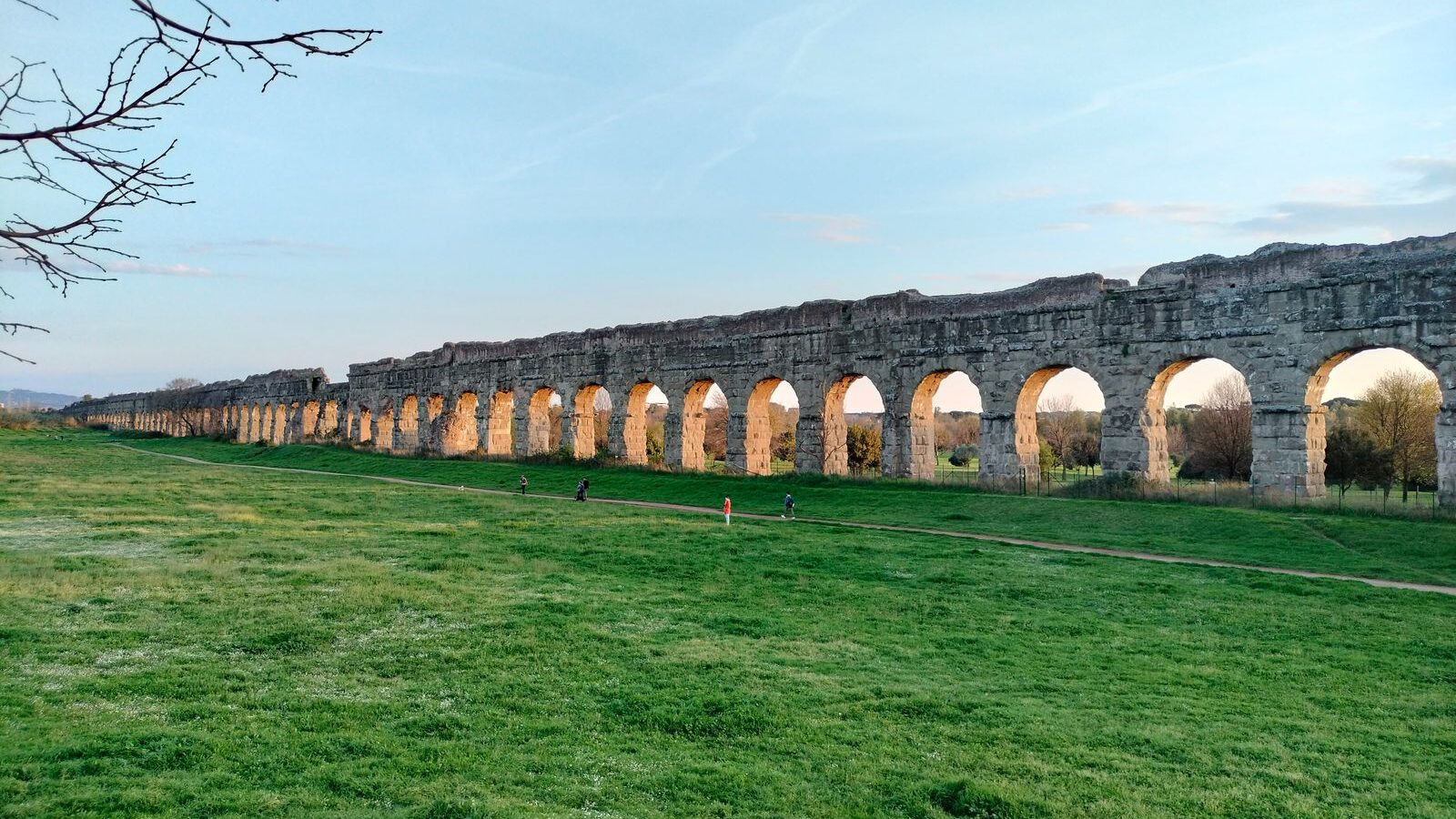
In the Roman Forum, the aqueducts are stubs behind a rope. Twenty minutes out on Metro A, you can lie on the grass beneath a whole one: a line of arches nearly two thousand years old striding across open fields, with joggers, dog-walkers and the odd football match going on underneath. To the people of the Tuscolano district it is simply the local park, and that is exactly the appeal.
Seven aqueducts in one field
The Parco degli Acquedotti covers about 240 hectares of old Roman countryside between the Via Appia and the Via Tuscolana, and forms part of the Appia Antica regional park. It sits at what was the great junction of ancient Rome’s water network, where the channels from the hills to the east converged on the city. Seven aqueducts pass through: the Anio Vetus, Aqua Marcia, Aqua Tepula, Aqua Julia, Aqua Claudia and Anio Novus from antiquity, plus the papal Acqua Felice, built from 1585 under Pope Sixtus V. Some of them run underground, and some still carry water today.
The one everybody comes for is the Aqua Claudia, begun under Caligula in AD 38 and finished by Claudius in AD 52. Its arches march across the park in a long, slightly ragged line, with the Anio Novus channel carried on top. Rome’s tourism office puts the highest stretches at close to 28 metres. Running alongside is the lower, more modest arcade of the Acqua Felice. Between them you’ll find the brick ruins of the Villa delle Vignacce, one of the largest Roman villas in the area, a short stretch of original paving from the Via Latina, and the Casale di Roma Vecchia, a medieval tower-house. A small stream, the Marrana, winds through the middle.
Arches on the big screen
If the view feels familiar, that is because cinema got here first. Federico Fellini opened La Dolce Vita (1960) with a statue of Christ dangling from a helicopter as it flies along the Aqua Claudia. Pier Paolo Pasolini filmed scenes for Mamma Roma in this area, and Paolo Sorrentino used the arches for one of the most talked-about scenes in La Grande Bellezza. With the Cinecittà studios just up the Metro line, the park has been a convenient backdrop for decades, Italian TV series included.
Getting there on Metro A
Take Metro Line A towards Anagnina and get off at Giulio Agricola, about 20 minutes from Termini. Lucio Sestio, one stop earlier, and Subaugusta, one stop later, are similar distances. From Giulio Agricola, walk south-west down Viale Giulio Agricola to the church of San Policarpo at its end. The park lies just behind it, off Via Lemonia, about 10 minutes from the station. The official address is Via Lemonia 256, and several gates open off that street onto the grass. There is no grand entrance or ticket office, so just head for the arches.
Rome’s Metro has seen evening closures and partial shutdowns for engineering work in recent years, so check ATAC’s service notices if you’re planning a sunset visit and need the train back.
A walk along the arches
The park is free and always open; the city’s tourism office recommends visiting from dawn to dusk. The ground is almost entirely flat, so it suits pushchairs, bikes and anyone who doesn’t want a climb. A simple route:
- Enter from Via Lemonia and walk straight to the Aqua Claudia.
- Follow the arches south-east, away from the city, towards the Casale di Roma Vecchia.
- Look out for the Via Latina paving and the Casale di Roma Vecchia, then loop back along the Acqua Felice and past the Villa delle Vignacce.
That takes an hour or two at an easy pace, longer if you bring a picnic. The best photo is not the one from the gate. Stand close to the Claudia and shoot down the length of the arches as they recede, ideally with a cyclist or runner in frame for scale. The ruins themselves are not to be climbed, however tempting the low walls look.
There is a children’s playground and a dog area, and a park info point that, according to the tourism office, opens on Sundays only and closes in January, February, July and August. There is no proper café inside the park, so bring water and buy picnic supplies from the shops and bars around Via Lemonia and Viale Giulio Agricola.
Light, heat and the right time of day
Come early in the morning or in the hour before sunset, when low light turns the brick orange and the arches throw long shadows across the grass. At midday in summer the park is shadeless and fierce; umbrella pines are few and far between. Spring is the prettiest season, green and full of wildflowers, while by August the grass has usually baked to straw. Weekend afternoons bring families and football; weekday mornings are close to empty. It is a residential park and fine by day, but it is large and thinly watched after dark, so head back to the Metro before night falls.
Why it beats the Forum, and what to pair it with
The Forum gives you fragments in a crowd. Here you see a Roman aqueduct doing what it was built to do, crossing miles of open land, which explains the scale of the water system far better than any single ruin downtown. Few tour groups come out this far, and the only cost is a Metro ticket.
Film fans can ride one stop past Subaugusta to Cinecittà for Cinecittà si Mostra, the studios’ exhibition, which ticket listings show as closed on Tuesdays and charging around €10. Check its own site before going. The nearby Tombe di Via Latina, another free Appia Antica site, closed in June 2026 for restoration with no reopening date announced yet. Back in the centre, the Centrale Montemartini continues the theme of ancient Rome meeting engineering, with classical statues set among old power-station turbines, and the Non-Catholic Cemetery in Testaccio is the city’s other great free pocket of calm.