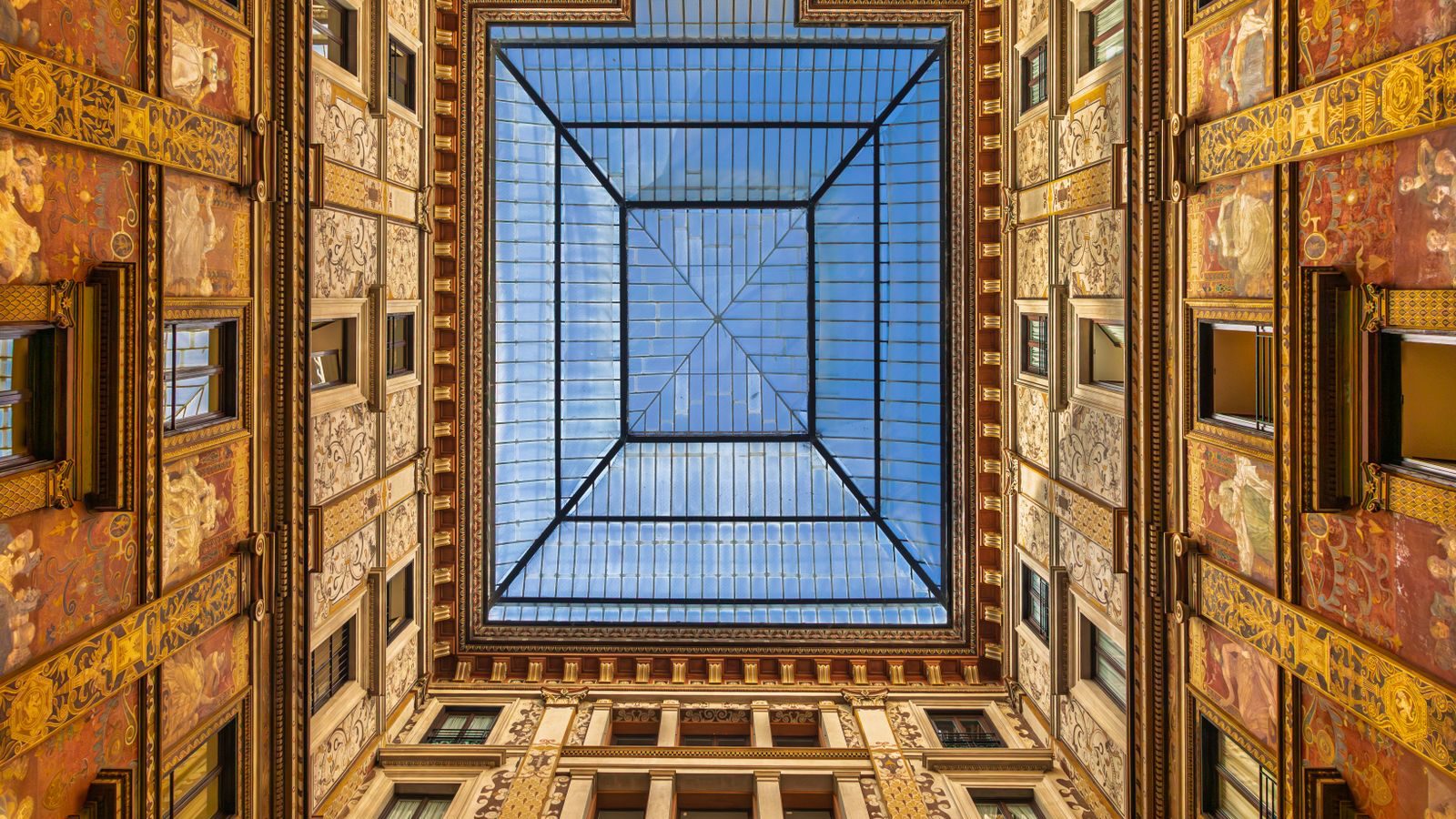
Around the corner from the Trevi Fountain, where the crowd is ten deep and selfie sticks clash overhead, an open gateway leads into what looks like an ordinary office building. Step through and the noise falls away. You are standing in a glass-roofed courtyard whose walls are painted from pavement to cornice with serene, larger-than-life women, garlands and gold lettering. Most people walking past never glance inside.
A prince’s courtyard, built for newspapers
The Galleria Sciarra sits inside the Palazzo Sciarra Colonna di Carbognano, a 16th- and 17th-century palace on Via del Corso whose grand portal was once counted among the “four wonders of Rome”. Between 1885 and 1888, Prince Maffeo Barberini Colonna di Sciarra had the architect Giulio De Angelis build a covered courtyard to link his various enterprises. The prince was a member of parliament and a publisher, and the complex housed the offices of the newspaper La Tribuna and the literary magazine Cronaca Bizantina, edited at one point by Gabriele D’Annunzio.
De Angelis, also known for Rome’s early department-store building for La Rinascente, loved modern ironwork. He gave the courtyard slender cast-iron columns and an iron-and-glass vault, which pours daylight onto the walls. The building was heavily reinforced with concrete in a 1970s restoration, but the paintings and the ironwork were preserved, and the space still feels very much of the 1880s.
Covered iron-and-glass galleries were the height of modernity in late-19th-century Europe, and Milan had finished its vast Galleria Vittorio Emanuele II about a decade earlier. The Sciarra is a much more intimate Roman take on the idea: one private courtyard rather than a shopping street, decorated less to sell anything than to make a statement about the family behind it.
How to read the walls
The decoration is by Giuseppe Cellini, working to a programme devised by the critic Giulio Salvadori. Everyone calls the paintings frescoes, but Rome’s tourism office notes that Cellini actually used encaustic, a wax-based technique. The theme is the Glorification of Woman, told in two bands:
- Up top: tall female figures personifying virtues such as Modesty, Sobriety, Strength, Humility, Prudence and Patience, each named in painted capitals (La Modesta, La Prudente and so on).
- Lower down: scenes of home life, with women gardening, sewing, dining and looking after children, framed by garlands, mottoes and Liberty-style ornament (the Italian version of Art Nouveau).
Read with modern eyes, it is a very 19th-century, very bourgeois picture of the ideal wife, and part of the fun is decoding that message. As decoration, though, it is gorgeous: soft colours, flowing lines and a sense of calm that Rome’s Baroque churches rarely offer. Stand in the centre, look up, and turn slowly through 360 degrees. The upper figures, just below the glass, are the best part and the easiest to miss from the doorway.
The anti-Trevi
The Trevi Fountain is spectacular, and it is also one of the most crowded squares in Europe. Since February 2026, stepping down to the basin itself costs €2 for non-residents. The Galleria Sciarra is a couple of minutes’ walk away, free, roofed and usually close to empty. Ten to fifteen minutes is enough. That is exactly why it works so well as a breather: see the fountain, slip away, and give your ears a rest in one of Rome’s very few Art Nouveau interiors. If the style grabs you, the city’s other big Liberty showpiece is the fairy-tale Quartiere Coppedè, a tram ride north of the centre.
Finding the door, and timing it right
The main entrance is at Via Marco Minghetti 10, between the Trevi Fountain and Via del Corso, and there is a second way in from Piazza dell’Oratorio. There is no sign announcing an attraction, so watch the house numbers. From the fountain, walk towards Via del Corso and you are there in about two minutes. The nearest Metro stop is Barberini on Line A, about 8–10 minutes on foot, and plenty of buses run along Via del Corso.
The catch is access. The galleria is a private courtyard in a working office complex, open to the public only during business hours on weekdays. Third-party listings in 2026 mostly give Monday to Friday from about 9:00 into the early evening, with different closing times, and the gates are normally shut at weekends. Treat it as a weekday daytime stop, and don’t build a Sunday plan around it.
- Best time: late morning on a sunny weekday, when light floods through the glass roof. On grey days the colours look flat.
- Cost: free, with no tickets or booking.
- Etiquette: people work here. Keep your voice down, don’t block the passage for a photoshoot, and leave the tripod at home.
- Access: it is a ground-level passage, so there is no climbing involved.
A short loop around it
Leave by the Piazza dell’Oratorio side and you are a couple of minutes from Santa Maria in Via, a church built around a medieval well, the Madonna del Pozzo, where worshippers still drink the water. Continue to Via del Corso and Piazza Colonna, where the spiralling Column of Marcus Aurelius stands opposite the Galleria Alberto Sordi, an early-20th-century shopping arcade. From there, the Pantheon is under ten minutes’ walk west.
Strung together, that makes an hour of central Rome that mixes the headline sights with corners the crowds walk straight past. If layered, hidden Rome is your thing, the Basilica di San Clemente, with its church beneath a church beneath a church, belongs on the same list.