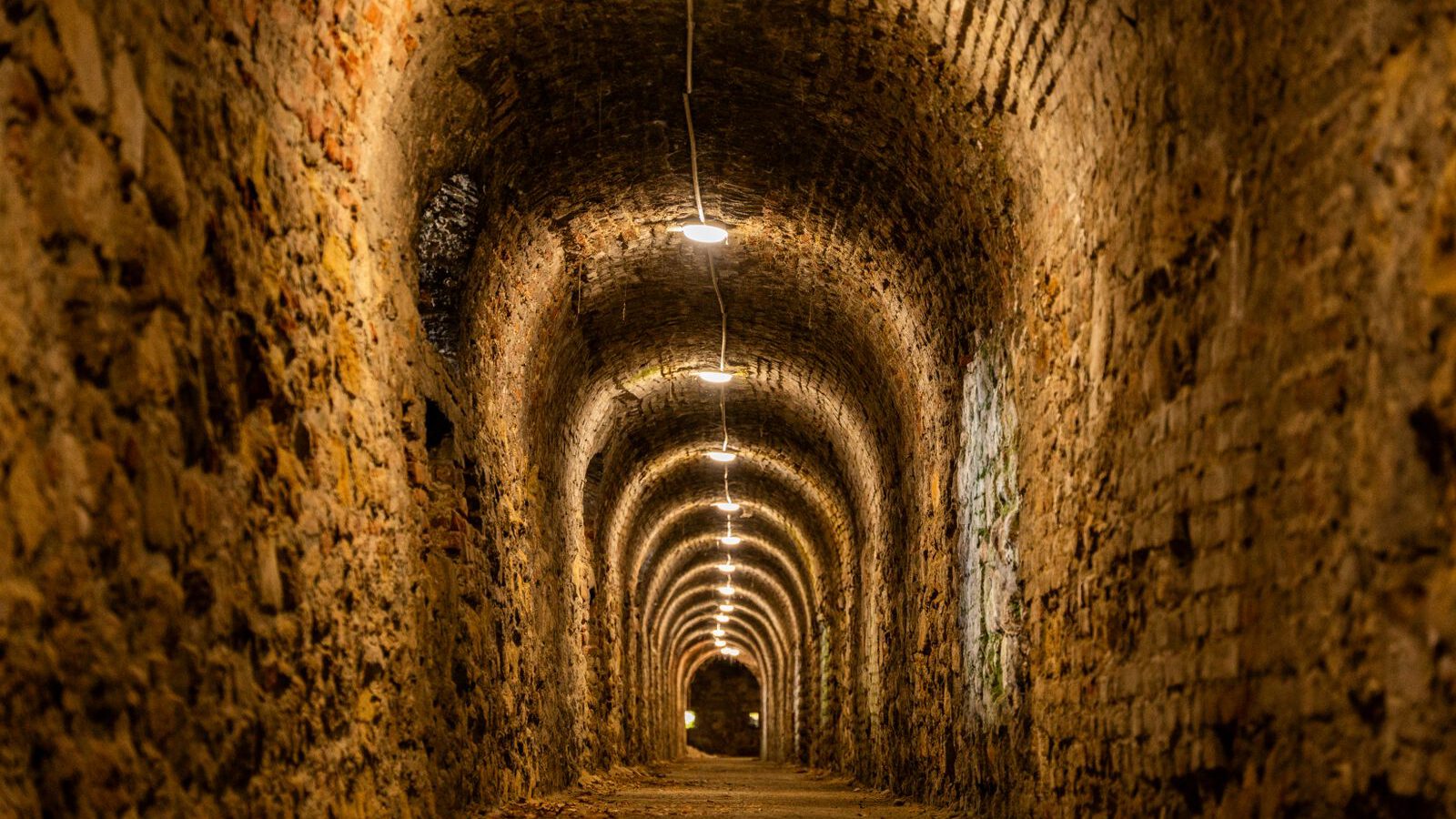
Five minutes from the Colosseum, behind an unremarkable brick front, is the single clearest lesson in how Rome physically grew — not a diagram of it, but the actual thing, stacked three storeys deep and cool enough to hear water running at the bottom.
A church on a church on a Roman street
San Clemente is a vertical cross-section through two thousand years, and you descend it one level at a time:
- Street level — 12th century. A glowing medieval basilica whose apse blazes with one of Rome’s greatest golden mosaics, the Triumph of the Cross, its vine tendrils curling around dozens of tiny figures. This part is free.
- One flight down — 4th century. The original early-Christian basilica, buried and built over, with worn frescoes telling the legend of St Clement in comic-strip panels.
- Another flight down — 1st–2nd century. A pagan Roman lane: brick alleys, a nobleman’s house, and a Mithraeum — a temple to the Persian god Mithras — with a carved altar showing the god slaying a bull. An ancient spring or drain still runs through the dark, and you can hear it.
You don’t read about Rome’s layers here; you walk down through them, floor by floor, into the cool and the quiet.
Is it worth it — and why not just do the Colosseum?
It’s one of the best-value historical experiences in the city, and it’s the perfect foil to the arena up the road. The upper church alone justifies the walk and costs nothing. But the paid excavations are where it becomes unforgettable, because instead of standing in a queue imagining ancient Rome, you’re actually inside it — a genuine Roman street, a working temple, the sound of a 2,000-year-old water channel echoing off the brick. For anyone who finds the Colosseum a bit of an anticlimax once they’re through the turnstile, this quiet descent is more atmospheric and far less crowded.
There’s a nice human thread running through it, too: the basilica has been in the care of Irish Dominican friars since the 17th century, and it was their nineteenth-century excavations that first uncovered the buried levels. Look in the lower church for a small painted scene captioned in blunt medieval speech — one of the earliest surviving fragments of written vernacular Italian, as opposed to Latin, scrawled beneath a fresco. It’s the kind of detail that turns “old church” into “the actual moment a language started being written down,” and it’s easy to walk straight past without a guide or a good guidebook.
Getting there
It’s on Via Labicana, a 5–7 minute walk east of the Colosseum. Nearest Metro is Colosseo (Line B); Line C’s San Giovanni interchange, tram 3, and several buses also stop close by. Because it’s so near the Colosseum and the Basilica di San Giovanni in Laterano, it drops neatly into a day you’re already spending in that corner of Rome.
When to go, tickets, and the fine print
The upper basilica is free. The underground excavations cost around €10 (reduced about €5), under-16s free with a paying adult, and you must reserve a timed slot — book online in advance, as spaces are capped and each visit runs about 30 minutes. Arrive around 10 minutes early. The basilica typically opens daily with a midday closure (broadly morning and mid-afternoon sessions, e.g. roughly 9am–12.30pm and 3–6pm), but hours change for services and holidays, so confirm on the official site and book the archaeology before you turn up. Restoration work has come and gone in the upper church, so a stretch of scaffolding is possible — worth checking when you book if the mosaic is your main draw.
Insider tip
The lowest level is noticeably cooler and damper than the street — a blessing in a Roman July, but bring a light layer in winter. When you reach the bottom, stop moving and just listen: the sound of running water is that ancient spring still feeding through beside the Mithraeum, and it’s the moment that gives the whole descent a genuine shiver. Photography rules tighten as you go down (often no photos at all on the lowest level), so read the signs rather than assume, and keep your phone away where it says to. Budget 45 minutes to an hour for all three levels at a pace that lets the layers sink in.