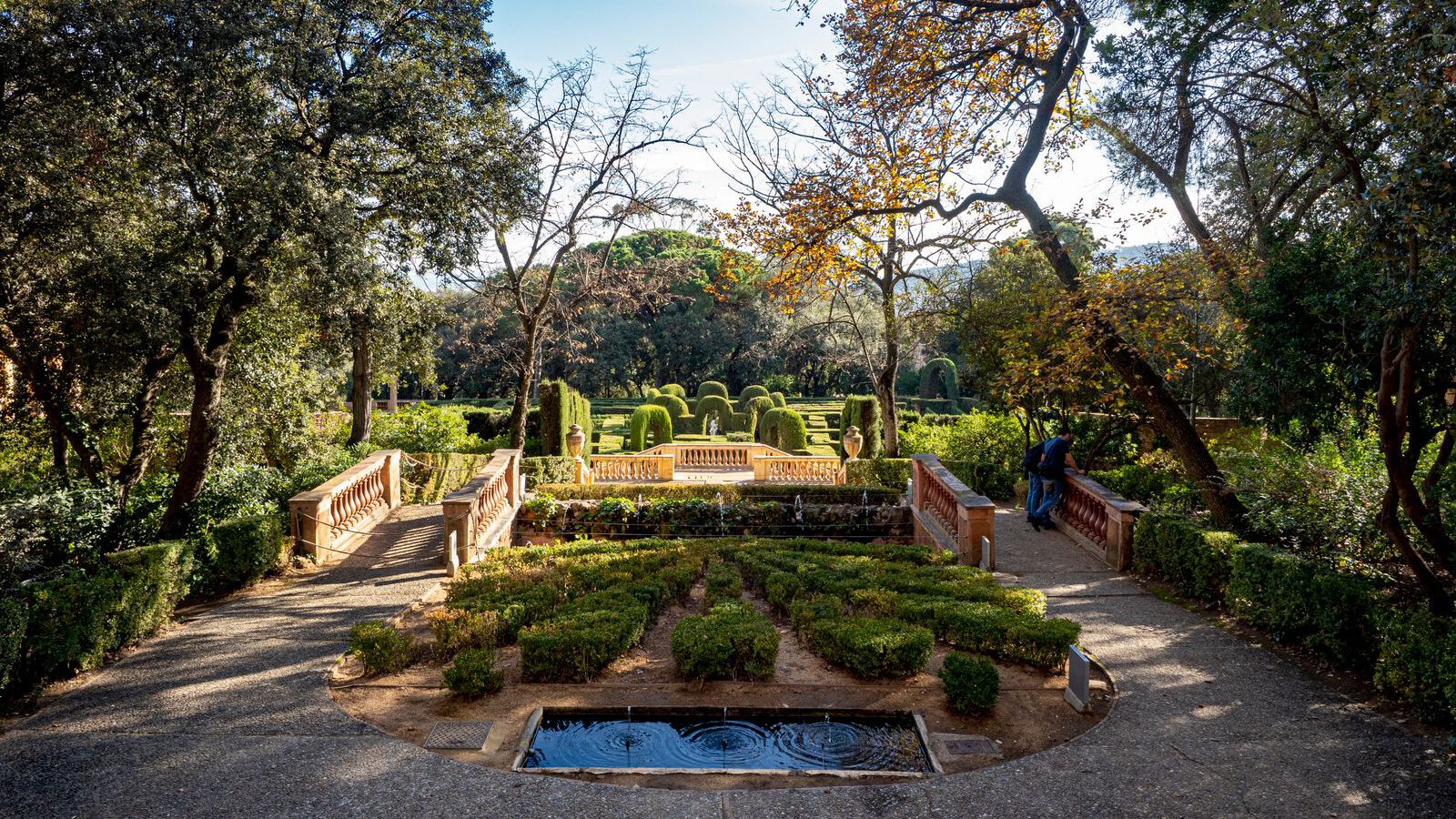
Barcelona’s oldest surviving garden sits right where the city runs out of streets: a walled estate on the lower slopes of the Collserola hills in Horta, where clipped cypress, stone staircases and marble gods were laid out for an aristocrat in the 1790s. It is small, formal and quietly theatrical, and at €2.23 it has one of the cheapest tickets in town. But 2026 has not been a normal year for it.
Check the status before you set off
Two separate closures overlap here. The famous hedge maze has been shut since early 2025 for a complete restoration: every cypress is being replaced with 2,211 new plants, the paths are getting permeable paving and a drip-irrigation system, and the sculptures are being restored. Planting started in December 2025, and the city’s own listing gives early 2027 for the maze to reopen, because the young hedges need months to take root before visitors are let back in.
On top of that, the whole park was closed on 13 March 2026 as part of the measures against African swine fever, which broke out among wild boar in the Collserola hills. It stayed shut through the summer, and in September 2026 the Catalan government extended the Collserola restrictions until at least the end of the year. So look up the park’s page on the Barcelona City Council website before you travel; it carries a closure notice whenever one applies. If the gates are shut, treat the rest of this guide as your plan for when they reopen.
A garden about love, with a corner about death
The estate belonged to Joan Antoni Desvalls, Marquis of Llupià and Alfarràs, who started work in 1791 with the Italian architect Domenico Bagutti. The French gardener Joseph Delvalet handled the planting and the master builder Jaume Valls ran the works. What they made is a neoclassical garden in the Italian manner, climbing three terraces and themed on love: pavilions with statues of Danaë and Ariadne, a bust of Dionysus, and at the top a pavilion dedicated to the nine Muses.
In the mid-19th century the architect Elies Rogent added a romantic garden on the left-hand side, and the mood changes completely: winding paths, a waterfall, moss, wilder planting and a theme that swaps love for death. Walking from one half to the other is the real pleasure of the place, a neat lesson in how differently two centuries imagined nature. The 18th century trimmed it into geometry; the 19th let it run wild. The Desvalls family handed the estate to the city in 1967, it opened as a public park in 1971, and a thorough restoration in 1994 turned it into a protected historic garden. That is why the rules here are stricter than in an ordinary park.
The maze, and why it is worth waiting for
The centrepiece is the cypress labyrinth on the lower terrace, roughly a kilometre and a half of hedge-lined paths. The story is told in stone. A marble relief of Ariadne and Theseus marks the entrance (she gave him the thread that got him out of the Minotaur’s labyrinth), a statue of Eros waits at the centre, and near the exit is the grotto of Echo and Narcissus, the myth of a love that went nowhere.
When it reopens, it will look different from the photos you find online. The new cypresses went in at 150 to 175 centimetres tall, so for the first few seasons the maze will be trimmer and greener than the dense old walls in older pictures. The layout itself is being restored to its original design.
Why come here instead of Park Güell
Park Güell is the reflex answer to “a garden in Barcelona”, and it comes with timed tickets and crowds. The Laberint is the opposite: a fraction of the price, shaded by old trees, and quiet enough to hear the fountains. It has no Gaudí, no mosaics and no sweeping city panorama. What it does have is calm, symmetry and a properly old garden, good enough that Tom Tykwer used it as a location for his 2006 film Perfume: The Story of a Murderer. An hour to an hour and a half is plenty for most people.
Tickets, hours and the rules at the gate
When the park is open, the official rules are:
- Hours: 1 April to 31 October, daily 10:00–20:00; 1 November to 31 March, daily 10:00–18:00, with a 10:00–14:00 opening on 25 December. Closing follows the daylight, and ticket sales stop an hour before closing.
- Price: €2.23 general, €1.42 reduced (under-14s, Carnet Jove holders, visitors with disabilities). Free for under-5s, pensioners, the unemployed and Horta residents with ID.
- Free days: everyone gets in free on Wednesdays and Sundays, but numbers are capped (750 people at a time) and on busy days visitors are asked to keep their stay under 60 minutes. Arrive at 10:00.
- Payment: card only, no cash. There are no advance bookings.
- Not allowed: food, pets, bikes, skates and balls. Eat before or after your visit.
- Access: the park is listed as accessible for people with reduced mobility, but it is a terraced hillside garden, so expect slopes.
Getting there, and making a half-day of Horta
Take the green L3 metro to Mundet, near the top of the line, and follow the signs uphill for about ten minutes, past the Velòdrom d’Horta, to the entrance at Passeig dels Castanyers 1. There is a small snack bar by the main entrance but nothing to eat inside the garden, so bring water.
Afterwards, walk down into the old village of Horta, roughly 20 to 25 minutes on foot. On Carrer d’Aiguafreda you can still see the 19th-century washerwomen’s houses and the stone washing basins once fed by wells. A few streets on, Plaça d’Eivissa is the village square, lined with long-running bars such as Quimet d’Horta, ideal for a vermouth and a sandwich. Horta metro station (L5) is right there, and from it the line runs straight down to the Modernista pavilions of Sant Pau, or you can head for the same district’s other hilltop, the old anti-aircraft bunkers on Turó de la Rovira.
History fans should also look at the Palau del Marquès d’Alfarràs, the family’s palace inside the grounds. The city has scheduled free guided visits from September 2026 to June 2027, on Wednesdays and Sundays at 10:30 and 12:00. They are in Catalan, and booking opens seven days ahead on the city’s parks website. Given the closures, confirm they are actually running before you plan around one.