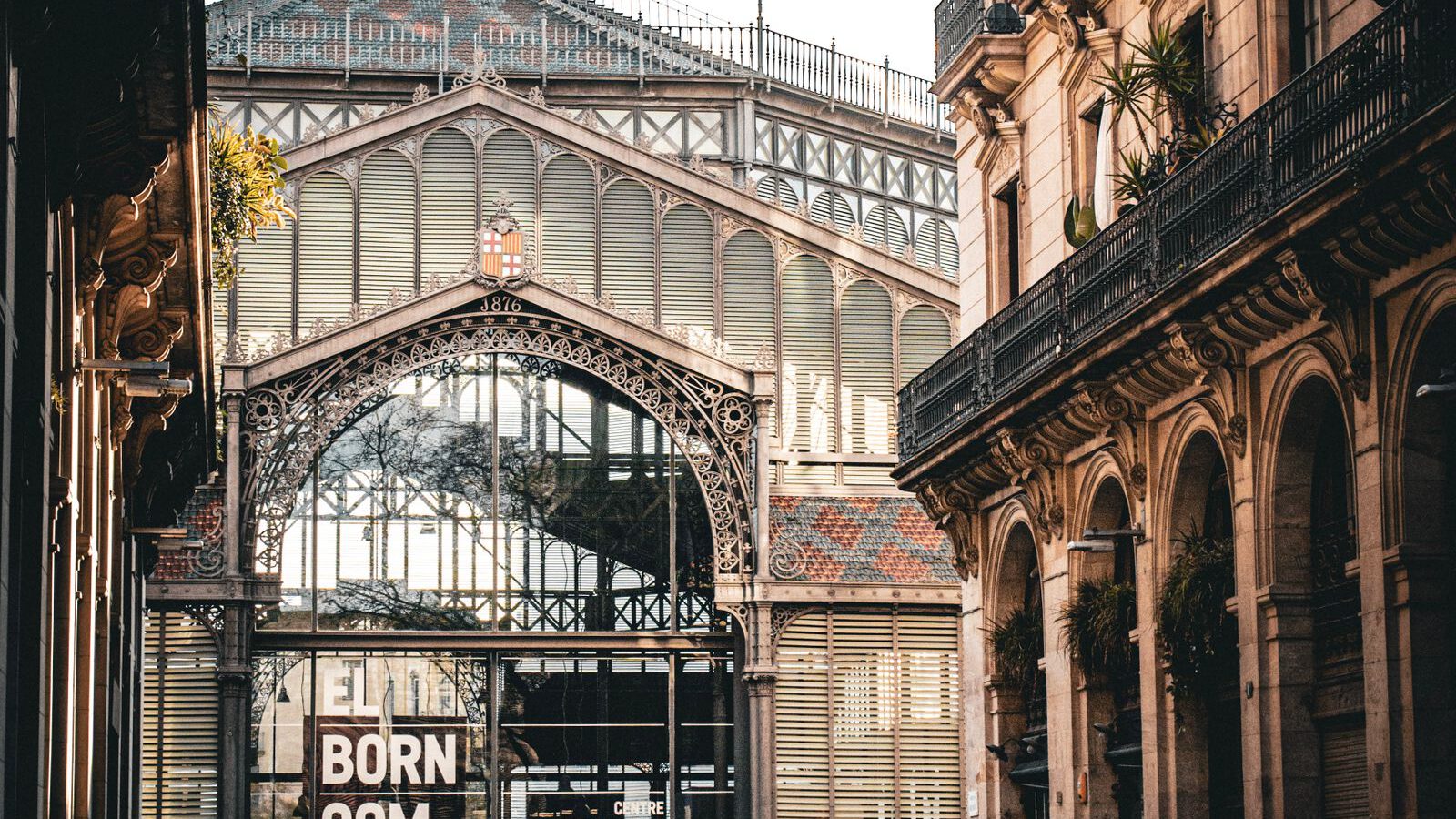
At the far end of the Passeig del Born, past the terraces and the cocktail bars, stands a huge iron-and-glass market hall. Walk in, and instead of fruit stalls you find a sunken grid of streets, house walls, wells and drains stretching almost the length of the building. This is a slice of Barcelona as it was on the day it surrendered in 1714, and entry to the hall costs nothing.
The neighbourhood that was wiped off the map
In the War of the Spanish Succession, Barcelona backed the losing side and held out against the troops of Philip V until it capitulated on 11 September 1714. To keep the city under control, the new Bourbon regime built a massive fortress, the Ciutadella, on the eastern edge of town. To make room for it and its open firing esplanade, a large part of the Ribera neighbourhood was demolished. According to the museum, 42 streets disappeared.
What you look at under the market is about 8,000 square metres of that lost district: sections of up to nine streets and the remains of about sixty houses spread over eleven blocks, cut through by the Rec Comtal, the medieval water channel that powered the workshops here. Archives have even made it possible to name many of the families who lived in these houses. That turns the walls from abstract rubble into somebody’s kitchen, somebody’s workshop.
From fruit market to museum
The hall above came later. The fortress was eventually torn down in the 19th century and its land became the Parc de la Ciutadella, laid out by Josep Fontserè, whose team also designed the Born market. It opened in 1876 as the first large iron-framed building of its kind in Barcelona. From 1921 it was the city’s wholesale fruit and vegetable market, until it closed in 1971.
Then came decades of argument about what to do with it. At the end of 2001, works to turn the hall into a provincial library hit the buried streets, and the library plan was dropped. The site was given protected heritage status, and the building reopened in 2013 as the El Born Centre de Cultura i Memòria. In 2025 it became part of the city’s history museum and changed its name to El Born. Museu d’Història de Barcelona, so expect to see both names on maps and signs. Its exhibition halls are being reworked as part of that relaunch, so check what is currently on show.
Free entry, paid tour: how to see it properly
Walking into the hall is free, and from the edges you can look down over the excavated grid. The museum is clear that free entry does not include access to the archaeological site itself. To go down among the ruins, you need the guided tour.
- Guided tour of the site: €4.20, reduced €2.90. English tours run Tuesday to Sunday at 16:00; Spanish tours Tuesday to Saturday at 16:30 plus weekends at 12:30; Catalan tours Tuesday to Saturday at 17:30 plus weekends at 11:30.
- Exhibitions: €3 for one, or €4.50 combined (reduced €3.15).
- Free admission: under-16s go free, and the museum’s ticketed spaces are also free on the first Sunday of each month and on Sundays from 15:00.
- Free extra: a small exhibition on the history of the market and the Ciutadella park sits in the entrance hall and needs no ticket.
If you can only do one thing, make it the 16:00 English tour. Without context, the site is a beautiful jumble of stone; with a guide pointing out a tavern here and a well there, it becomes a street you can almost walk down. Allow 30 to 45 minutes on your own, and up to two hours with a tour and an exhibition.
Why it beats another lap of the Gothic Quarter
The Gothic Quarter sells old Barcelona as a backdrop, and a fair amount of what you see there was restored or embellished in the 20th century. El Born shows you the real thing: an ordinary working neighbourhood stopped dead by a political decision, with the evidence still in the ground. It also explains why 11 September is Catalonia’s national day, the Diada, which makes a lot of Barcelona’s politics easier to understand. And because most visitors stroll straight past the doors on their way to the beach, the hall is rarely crowded.
Hours and getting there
The entrance is at Plaça Comercial 12. From March to October it opens Tuesday to Sunday, 10:00–20:00. From November to February it opens 10:00–19:00, staying open until 20:00 on Sundays and public holidays. It is closed on Mondays (except public holidays) and on 1 January, 1 May, 24 June and 25 December, and last entry is 30 minutes before closing. Hours are set by the history museum and do change, so check its website before a late visit.
The nearest metro stops are Jaume I and Barceloneta, both on the yellow L4 and both a short walk of five to eight minutes. From Jaume I, walk down Carrer de l’Argenteria to Santa Maria del Mar, then follow the Passeig del Born to its end. Arc de Triomf (red L1) is a 10–12 minute walk through the edge of the Ciutadella park. Since it is indoors and level, it works on a rainy day or in the midday heat.
A 1714 walk around the block
Turn the visit into a short walk through the same story. Go up the Passeig del Born to Santa Maria del Mar, and beside it you’ll find the Fossar de les Moreres, a square built over the burial ground of defenders who died in the siege, paved in deliberately blood-red brick and marked by a tall memorial topped with an eternal flame. Then cross the road from the market into the Parc de la Ciutadella, standing on the ground of the fortress that caused all this.
If iron market halls with history underneath catch your imagination, the Mercat de Sant Antoni has remains of the old city defences on show in its basement. The same history museum also runs the Refugi 307 air-raid shelter on Montjuïc, a very different chapter of the city’s past. And afterwards, the lanes around the Passeig del Born are full of small bars, so a vermouth is never far away.