
The “lemon dome” on the hill
From the western edge of Vienna, look up toward the Wienerwald and you’ll spot a gleaming copper-gold dome the locals nicknamed the Limoniberg — “lemon mountain.” That’s the Kirche am Steinhof, officially the Church of St. Leopold, finished by Otto Wagner in 1907 as the chapel for what was then Europe’s most modern psychiatric hospital. It is, without much argument, the finest Jugendstil (Art Nouveau) interior in the city — and one of the most important Art Nouveau buildings anywhere.
What makes it extraordinary is that Wagner designed it as a Gesamtkunstwerk, a total work of art, right down to the door handles. Koloman Moser’s mosaics and stained glass glow above a floor of white and gold; the whole thing is one unbroken idea.
Architecture designed for its patients
The details that stay with you are the humane ones. Because this was a working hospital church, Wagner built in features you’d never notice without prompting:
- A gently sloping floor so it could be hosed down and drained after services.
- Rounded pew corners and few sharp edges, to reduce injury.
- Short, wide pews and side aisles that let staff reach any patient quickly.
- Easy-access side exits and a separate entrance, so anyone in distress could be led out discreetly.
- Even the holy-water fonts were designed with hygiene in mind — running water rather than a shared basin.
It’s rare to stand in a building this beautiful that was also this thoughtful about the vulnerable people who first used it.
Is it worth the trek out?
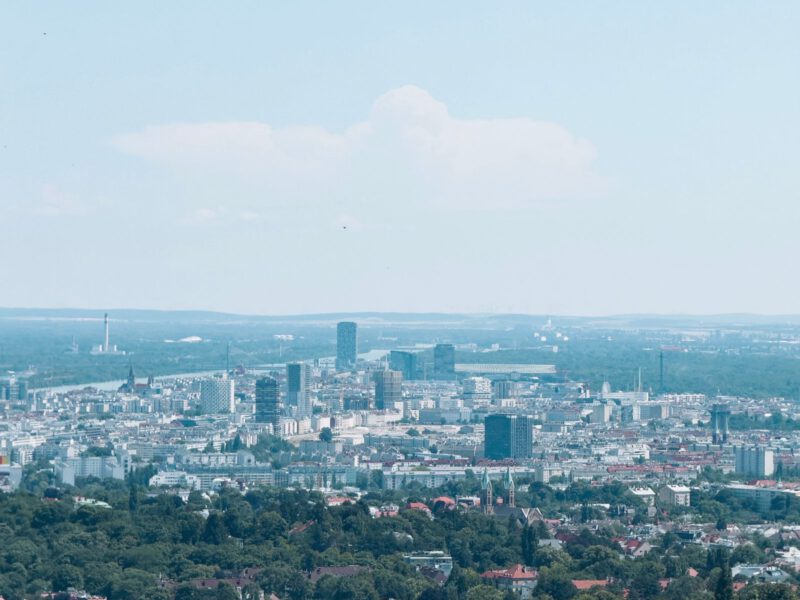
Yes — and it’s the smart alternative to fighting the Belvedere crowds for a glimpse of Klimt. Here you get world-class Vienna 1900 design in near silence, plus a leafy hilltop park with wide views back over the city. The catch is access: the interior is only open a few days a week in the warmer half of the year, and it’s genuinely out on the edge of town, so this is a half-day commitment rather than a quick tick.
Getting there
Take the U3 to its western terminus, Ottakring, then change to bus 48A and ride up to the Otto-Wagner-Spital / Otto-Wagner-Areal stop. From there it’s a five-to-ten-minute walk uphill through the old hospital grounds to the church at the very top. The last stretch feels more like a short hike to a hilltop chapel than a city sightseeing stop — sensible shoes help, and it’s not the easiest approach if you have mobility issues.
Opening times, tickets and the one tip that matters
The church is run by the Wien Museum and opens for the warmer season only — broadly spring into autumn, on a limited weekly schedule (recently Tuesday–Friday plus weekend afternoons), with a winter break and the occasional longer closure for conservation. Always check the Wien Museum website for current dates and hours before you set out — a wasted trip out here really stings. Admission is around €5 (reduced roughly €4), and the first Sunday of the month is free at Wien Museum sites.
The tip: time your visit for a guided tour if you possibly can. Much of the genius here is invisible without a guide — the sloped floor, the emergency exits, why the mosaics were built to be legible to patients who couldn’t sit still. A self-guided visit is lovely; a guided one is a different, richer experience.
Make a morning of it
Don’t just bus up, see the church, and bus straight back. Walk five minutes across to the Steinhof-Gründe meadows behind the complex for one of the quietest panoramas of Vienna you’ll find — no railings, no crowds, just the city spread out below. Then loop down through the parkland of the old sanatorium (its scattered pavilions are an architecture story in themselves) rather than retracing your steps to the bus. Bring water; café options up here are thin.