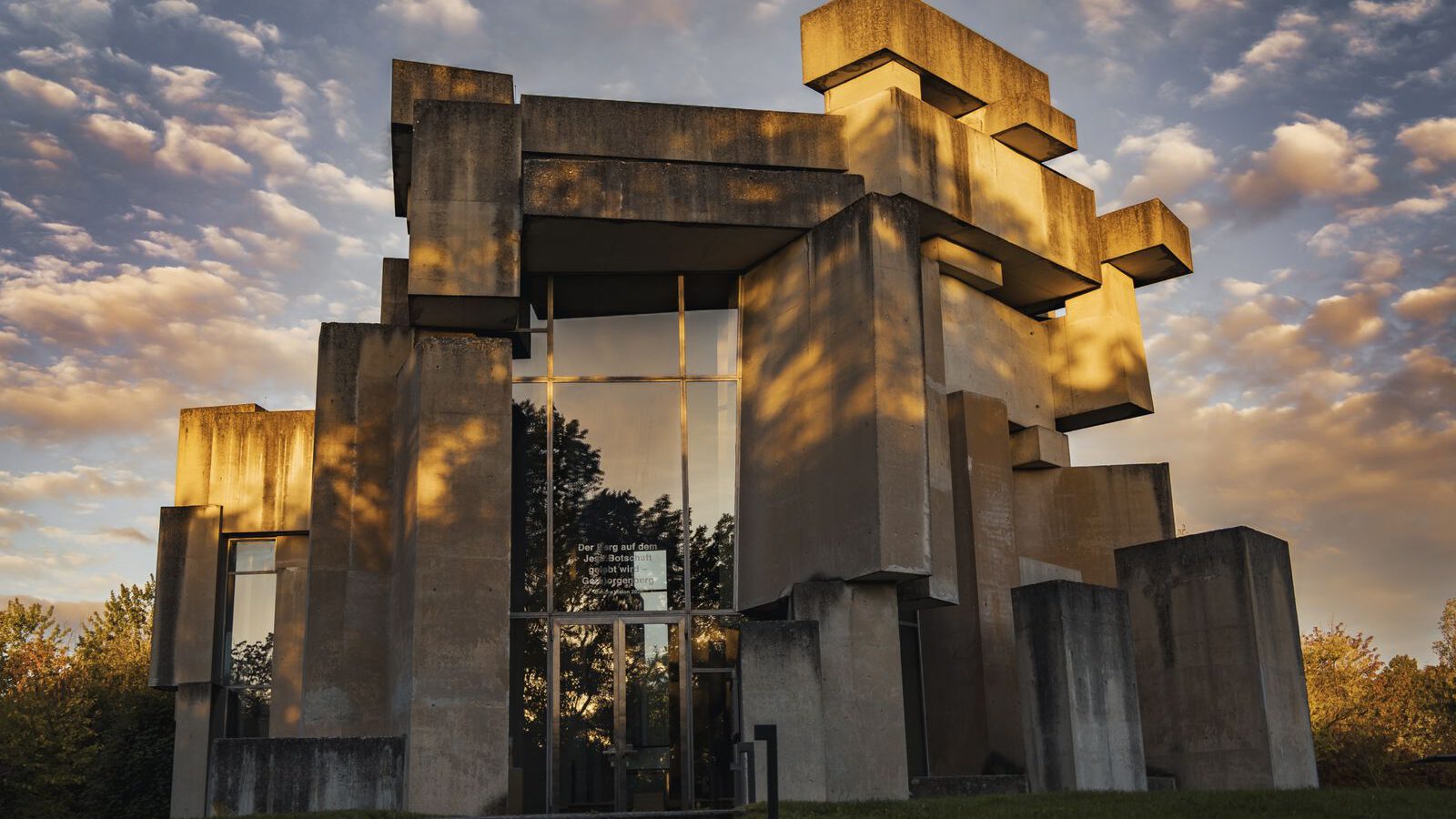
Vienna’s famous churches are about gold, marble and painted ceilings. The Wotrubakirche, officially the Church of the Most Holy Trinity, is about the opposite: raw grey concrete blocks piled on a wooded hill in the city’s far south-west, looking from a distance like a rockslide that froze in place. It is free, rarely busy and genuinely moving inside, but it is open for only a few hours a week, so a visit takes a little planning.
A sculptor’s last work and the woman behind it
The church exists because of two very different people. Margarethe Ottillinger was an Austrian ministry official who was arrested by Soviet forces in 1948 and spent seven years in Soviet camps, where she became a devout Catholic. Back in Vienna she set out to build a church, and through the art-loving priest Otto Mauer she found the sculptor Fritz Wotruba. Planning began in 1964, but the design was so unusual that it took another twelve years of resistance and debate before it was finished. Wotruba died in 1975, mid-construction; the architect Fritz Gerhard Mayr, who had drawn up the plans, saw it through. It was consecrated on 24 October 1976, on the Georgenberg in Mauer, a site that had held military barracks during the war. The square in front of it now carries Ottillinger’s name.
From outside a rockfall, from inside a lantern
Most sources describe 152 concrete blocks (the parish’s own website gives 135), stacked without symmetry and ranging from small slabs of under two tonnes to a single block of around 141 tonnes; the tallest stands about 13 metres high. No two are alike. Up close the exterior feels heavy, almost hostile, and that is part of the point: Wotruba wanted to show that austerity did not have to be ugly.
Step inside and the mood flips. The gaps between the blocks are filled with plain glass, so daylight enters in narrow vertical slits of different heights, throwing bright stripes across the concrete that move as the sun moves. The altar wall holds a cast of a cross by Wotruba. Sound carries and echoes in the bare space. Below the church is a parish hall, which is why this feels like a living community church rather than a monument.
Opening hours are the whole plan
This is the detail that catches people out. The interior is open only:
- Saturday 14:00–18:00, followed by an evening Mass at 18:30.
- Sunday and public holidays 09:00–16:30, with Mass from 9:30 to about 10:30. On holidays without a Mass, it opens from 12:00.
- Monday to Friday: closed to visitors. You can still walk around the outside at any time.
Entry is free. If you want the full story, the parish arranges guided tours in German, English, French or Italian by request (email guidedtour@georgenberg.at), including for groups outside normal hours. During the “Kunst am Georgenberg” art exhibition in mid-August there are public tours as well. Times can change around church holidays, so check georgenberg.at before you make the trip.
Getting out to the Georgenberg
The address is Ottillingerplatz 1, 1230 Wien (corner of Rysergasse and Georgsgasse), in the 23rd district, well beyond the U-Bahn network. Allow 45 minutes to an hour from the centre.
- Classic route: U4 to Hietzing, then tram 60 towards Rodaun to Maurer Hauptplatz. From there take bus 60A two stops to Kaserngasse and walk roughly ten minutes uphill.
- Walk it: from Maurer Hauptplatz it is about 20–25 minutes on foot, uphill through the quiet residential streets of Mauer.
- From the U6: bus 60A also starts at U6 Alterlaa and runs via Maurer Hauptplatz to Kaserngasse, which can be handier if you are staying near the Gürtel.
Hop-on hop-off buses don’t come out here. Check a live journey planner such as the Wiener Linien app before you set off, since connections at the bus stop can involve a wait.
Light, timing and manners
- Pick a bright day. The interior depends on sunlight through the slits; under heavy cloud it is still impressive, but far flatter.
- Avoid Mass times unless you want to attend. Late Sunday morning, after about 10:45, or a Saturday afternoon is the sweet spot.
- Give it time. The building is compact; 15 minutes covers it, but half an hour sitting still lets you see the light change.
- Accessibility: the main entrance has about 20 steps, but an extension added in 2018–19 has a lift from the car park level, usable during opening hours, plus an accessible toilet.
- Be discreet. This is a working parish church: photograph quietly, skip the flash and keep voices down when people are praying.
Make a half-day of Mauer
The Georgenberg sits on the edge of the Maurer Wald, part of the Vienna Woods, so a walk in the trees is the easiest add-on. Mauer is also an old wine village, and its Heurigen (wine taverns serving the local vintage) are the southern, far less touristy counterpart to the famous ones in Grinzing below the Kahlenberg. Heurigen open on rotating schedules, so check which ones are pouring on your day. If you are building a trail of Vienna’s architectural rule-breakers, pair the Wotrubakirche with Otto Wagner’s gilded Art Nouveau Kirche am Steinhof: two radical churches, 70 years apart, that could hardly look more different.