A power station dressed as a fairy tale
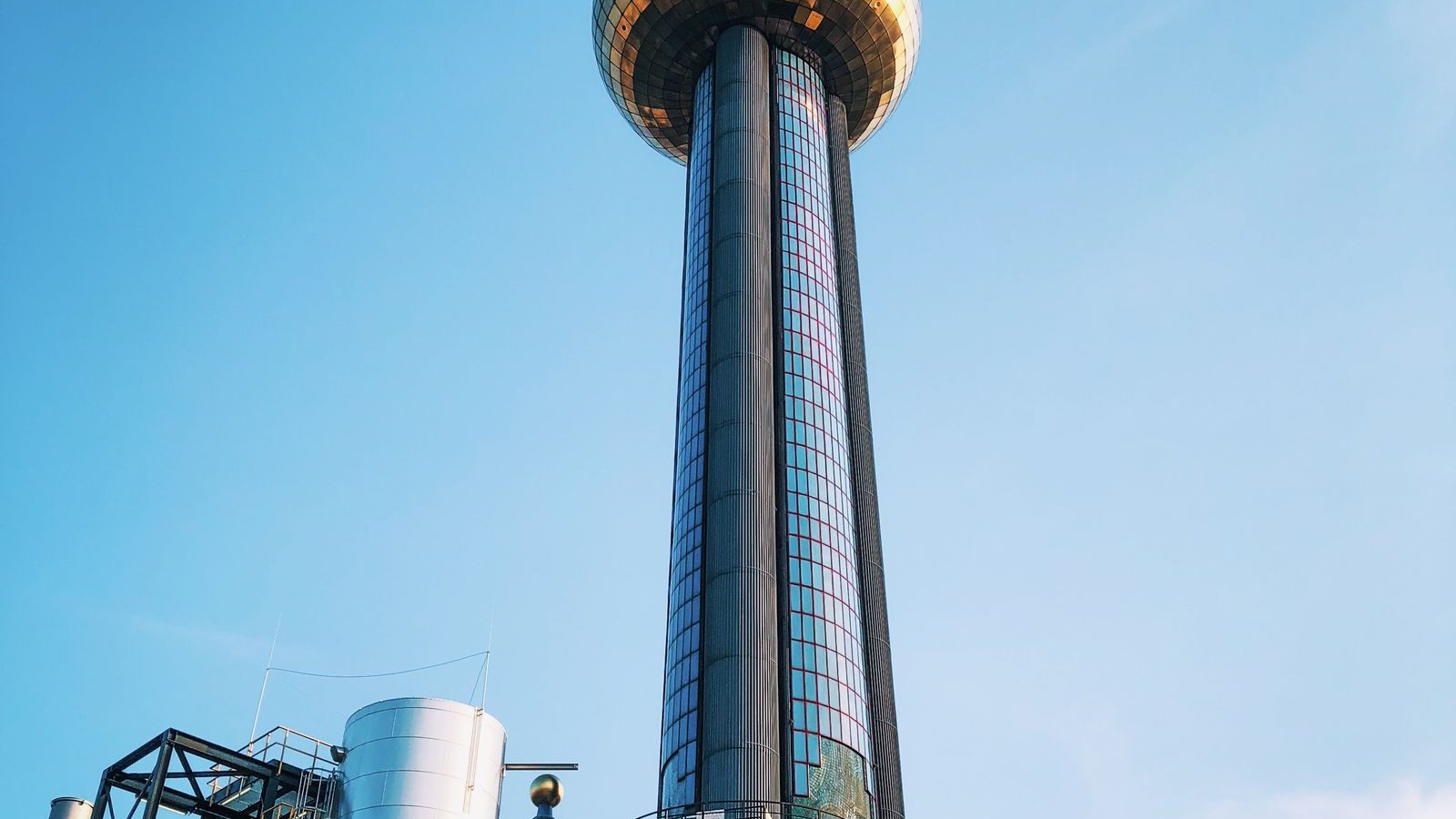
Fernwärme Spittelau is one of the strangest sights in Vienna: a fully operational waste-to-energy plant that also happens to be a Friedensreich Hundertwasser artwork. After a 1987 fire gutted the original incinerator, the city asked Hundertwasser to reimagine it — on condition the technology inside be made as clean as possible — and he wrapped the whole thing in his trademark riot of colour: mosaic-tiled walls, wavy black-and-white lines, tufts of greenery, gold flourishes, and a mirrored golden ball perched on top of the chimney like a full stop. It reopened in 1992 and still burns the household rubbish of central Vienna, piping district heating to tens of thousands of flats. Trash goes in; warm radiators come out; and the building is beautiful.
Is it actually worth a stop?
For a free, ten-minute detour, absolutely — and it’s a far easier Hundertwasser fix than the Hundertwasserhaus and its tour-bus “village” across town, where you can’t even go inside and the crowds are relentless. Be clear on what this is, though: you don’t tour the interior (it’s a live plant), so the whole experience is the exterior. Manage expectations and you’ll enjoy it; turn up expecting a museum and you’ll be puzzled. What you’re really here for is the idea it embodies — a city that burns its waste to heat its homes, and then decides that infrastructure should be joyful rather than hidden.
What you’re actually looking at
Spend a moment decoding it and the facade rewards you. Hundertwasser hated the straight line and the identical, so the building is a catalogue of his signatures:
- The golden ball — the mirrored orb crowning the chimney, and the whole plant’s exclamation mark.
- No two windows alike — his “window right,” where every opening is its own shape and size, so the block never reads as a machine for offices.
- Undulating ceramic tiles and wavy black lines — the ground refusing to lie flat, a Hundertwasser trademark you’ll also spot at the Hundertwasserhaus.
- Tufts of planting and “tree tenants” — greenery worked into the structure, softening the industrial bulk.
- Gilded flourishes and mosaic patchwork — the colour that turns a chimney stack into something closer to a piece of jewellery.
It’s worth knowing the backstory too: when the city approached him after the fire, Hundertwasser initially refused — he didn’t want to prettify pollution — and only agreed once assured the rebuilt plant would use the cleanest available flue-gas scrubbing. The result is a piece of civic philosophy in tile and gold: infrastructure that’s honest about what it does, and insists on being beautiful anyway.
How to get there (it’s almost too easy)
Both the U4 and U6 stop at Spittelau, and the plant is directly beside the station — you’ll clock the golden ball before you’re even out of the ticket hall. Tram D and several buses also pass close by. Because it sits between the university quarter and Heiligenstadt, it slots neatly into a bigger day: pair it with the U4 ride out to the Kahlenberg vineyards, or catch it on the way back into the centre.
Timing, cost and the shot you want
Viewing the outside is free and possible any time. If the machinery genuinely interests you, the operator Wien Energie occasionally runs guided tours of the working facility — these must be booked ahead and aren’t always on the schedule, so check their site rather than turning up hoping. For the other 99% of visitors, the plan is simple: a few photos and back on the train.
The one real tip: come at dusk. In daylight it’s a fun, oddball splash of colour. After dark, the illuminated golden ball and the lit mosaics against a black sky are properly striking — and the elevated U-Bahn footbridge over the station gives you a clean, fence-free vantage point looking down onto the chimney. Shoot from there.
Where to go next
From Spittelau you’re a short hop or a pleasant walk from the Danube Canal towpath, one of the nicest low-key ways back into town — increasingly lined with street art, pop-up bars and, in summer, sand-floored beach bars. A ten-minute curiosity here can easily become an unhurried riverside evening.