
A cemetery bigger than a small town
The Wiener Zentralfriedhof isn’t a graveyard you “pop into” — it’s roughly 2.5 square kilometres of wooded avenues, chapels and meadows on the city’s south-eastern edge, opened in 1874 and holding more burials (around three million) than Vienna has living residents. Think of it as a landscaped park that happens to be full of the dead: joggers use it, deer and hares graze the quiet plots, and squirrels will absolutely mug you for a walnut near the composers’ graves. It’s free, it’s vast, and it is far more uplifting than it has any right to be.
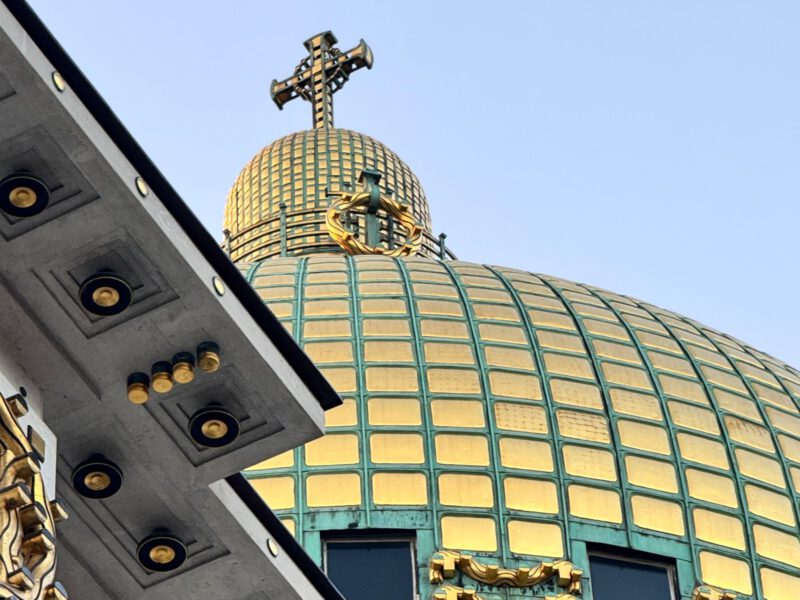
At its heart stands the copper-domed Dr.-Karl-Lueger-Kirche (also called the Karl Borromäus church), Max Hegele’s 1911 Art Nouveau church that would be a landmark anywhere else in the city. Around it fan the Ehrengräber — the honour graves — where Vienna parks its musical royalty.
Who’s actually buried here — and who isn’t
Group 32A is the reason most people ride out. In one leafy semicircle you get Beethoven, Schubert (both re-interred here), Brahms, Johann Strauss the Younger, Gluck, Suppé and a Salieri memorial, arranged around a central Mozart monument. Here’s the twist worth knowing before you go: Mozart isn’t in it. He was buried in an unmarked communal grave at the older St. Marxer Friedhof across town, so the Zentralfriedhof “Mozart grave” is a cenotaph — a memorial with nobody underneath.
A few minutes’ walk away in Group 40 is the grave that draws a different crowd: Falco, the “Rock Me Amadeus” star, under a black granite slab that fans keep decorated with candles, photos and the odd bottle. It’s become a genuine pilgrimage site, and it’s a short, easy add-on to the composers’ loop.
Getting there: ride the “71” like a local
Take tram 71 — it starts around Schwarzenbergplatz and runs along the Ring — all the way to the “Zentralfriedhof 2. Tor” stop (Gate 2, Simmeringer Hauptstraße 234). This is the main entrance and it drops you almost on top of the church and the honour graves. The line is so bound up with the trip that old Viennese slang for dying is “taking the 71.” Tram 6 also stops nearby, and the S-Bahn line S7 (the airport line) calls at a station right by the cemetery if you’re coming from further out. From Gate 2, walk straight ahead toward the dome: the composers are about five minutes in.
Hours, cost, and how long to give it
Entry is free. Opening hours track daylight: roughly 08:00–17:00 in deep winter, stretching to about 07:00–19:00 from spring through early autumn, with late closings (around 20:00) at the height of summer — check current times before a late-day visit, because the gates really do lock. Give yourself at least two hours; realistically half a day if you want to wander rather than tick off names. Wear proper walking shoes — the distance from Gate 1 to Gate 3 alone is over a kilometre.
Autumn is the standout season, when the avenues go copper and gold; a clear spring morning is best for birdsong and photos with low, soft light.
What most people miss (and what to skip)
The famous graves are the appetiser. Here’s where to actually spend your time:
- The old Jewish section by Gate 1 — romantically overgrown, ivy swallowing toppled headstones, and one of the most quietly moving corners in the whole city. Bring this into your loop; it’s the opposite of the manicured honour graves.
- The Präsidentengruft — the vault of Austria’s presidents, tucked behind the Lueger church.
- The Bestattungsmuseum (Funeral Museum) near Gate 2 — a genuinely fascinating small museum on Vienna’s famously theatrical relationship with death (the “schöne Leich”, the beautiful corpse). It charges a modest fee and is more compact than you’d expect, so treat it as a 30-minute add-on, not a headline.
- Café Oberlaa at Gate 2 — a proper branch of the city’s beloved konditorei, and the only reliable spot for coffee and cake once you’re inside. Fuel up here; there’s almost nothing deeper in.
Grab a free map at the Gate 2 Infopoint (they also rent audio guides and even e-bikes for the far corners), fill a water bottle, and don’t over-plan — the pleasure here is getting mildly lost among the mausoleums with an entire avenue to yourself. If your legs give out, the internal bus and the e-bikes exist for exactly that reason.