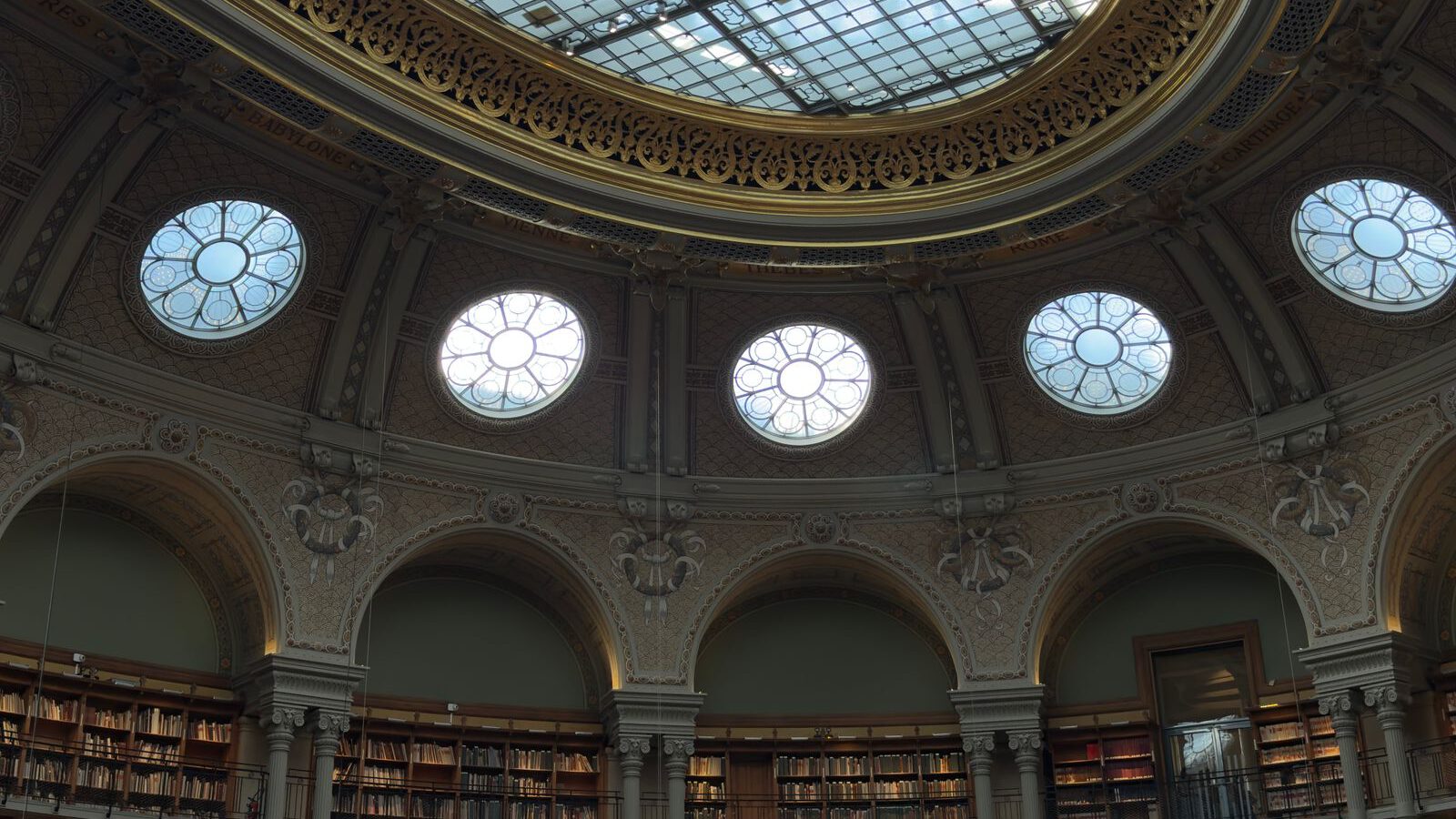
Most of the great interiors in central Paris come with a timed ticket, a security line and a one-way route that keeps you shuffling. The Salle Ovale at the Bibliothèque nationale de France’s Richelieu site asks for none of that. You walk in off Rue Vivienne, take a seat under one of the most beautiful glass roofs in the city, pull a book off the shelf and stay as long as you like. No library card, no registration, no age limit, no charge.
A reading room forty years in the making
Richelieu is the historic home of France’s national library: a cluster of buildings around the 17th-century palace of Cardinal Mazarin, where the royal library moved in 1721–22. In the 1860s Henri Labrouste added the famous reading room that bears his name, with its slender iron columns and nine domes. The Salle Ovale came later and took a remarkably long time. Jean-Louis Pascal started building it in 1897, Alfred Recoura finished it in 1932, and President Albert Lebrun inaugurated it in December 1936.
The result is an oval amphitheatre of a room, lit from a huge glass roof and ringed with tiers of bookshelves and galleries. It closed in September 2016 as part of the site-wide renovation, a restoration helped along by more than 2,700 private donors, and reopened in September 2022 as a room open to anyone at all.
What is on the shelves, and how to use it
More than 20,000 books sit on open shelves around 160 seats. The surprise is the comics: around 9,000 volumes, from 1830s picture stories to French and Belgian classics, manga, American and African titles. There are also dictionaries, encyclopedias, French history and genealogy, more than 2,000 works of French literature and about 6,000 books drawn from the library’s specialist departments, from maps and prints to music and coins. Most of it is in French, but the comics and the art books work in any language.
- How it works: find a free seat, take what you want from the shelves, and leave it on the desk or put it back. Nobody checks why you are there.
- Wi-Fi: there is a free network, plus large interactive screens that let you browse the library’s digitised treasures.
- Etiquette: people are working, so keep your voice low. Photos are fine without flash; do not set up a tripod or a shoot.
- With kids: teenagers who like manga or bandes dessinées may refuse to leave; younger children need to be able to sit quietly.
Fifteen minutes is enough just to look up at the roof. But the real swap here is time: instead of paying to queue for a timed slot at Sainte-Chapelle or the Palais Garnier and shuffling through in half an hour, you get to sit inside a landmark interior for an entire afternoon, for free.
Getting in: the right door, and what to leave at home
The visitor entrance is at 5 rue Vivienne in the 2nd arrondissement. Bourse on line 3 is the closest station, about four minutes’ walk; Pyramides (lines 7 and 14) and Palais Royal–Musée du Louvre (lines 1 and 7) are roughly eight minutes away. Buses 20, 29, 39, 74 and 85 stop nearby.
- Bags: only cabin-size luggage is allowed (55 × 35 × 25 cm), and backpacks, umbrellas and helmets have to go in the cloakroom. Travel light.
- Step-free access: wheelchair users enter through the separate door at 58 rue de Richelieu, round the corner.
- Cost: free for the Salle Ovale, the garden and the public areas; no booking.
When to go
The Salle Ovale is open Tuesday 10:00–20:00 and Wednesday to Sunday 10:00–18:00, and closed on Mondays and French public holidays. The whole BnF also shuts for an annual break in early September; in 2026 that ran from 31 August to 6 September, so check bnf.fr if you are visiting around then.
Tuesday’s late opening is the slot most visitors overlook, and the light through the roof shifts as the evening comes on. Weekend afternoons tend to be busiest, when free seats can be scarce, though you can always stand at the edge and look. On a hot summer day or a wet winter one, it is one of the best free places in central Paris to sit down for an hour.
The rest of Richelieu, free and paid
Do not leave straight after the Oval Room. The Jardin Vivienne, the library’s new garden designed by Gilles Clément and others, is planted with species once used to make paper and writing materials, and it is free to wander. There is a café run by Rose Bakery (Tuesday to Sunday, 10:00–18:00) and a good bookshop. You can also look into the Salle Labrouste, the even more celebrated 1860s reading room, from a glass vestibule; it is a research library, so you cannot sit inside.
The separate BnF museum, with the painted Galerie Mazarin, the Salon Louis XV and the cabinet of treasures from the royal collections, is ticketed: €15 full price or €10 reduced (including under-26s and students under 35), free for under-18s, with a combined museum-and-exhibition ticket at €18. Same opening hours as the Salle Ovale.
Around the corner: passages and the Palais-Royal
Step out of the Rue Vivienne entrance and the Galerie Vivienne, a glass-roofed 1820s shopping passage with a mosaic floor, has an entrance a few steps away on the same street and is open daily until the evening. The Galerie Colbert runs alongside it, and the gardens of the Palais-Royal are a few minutes south, free and full of benches. From there you can walk east in about 25 minutes into the Marais for something much stranger, the Musée de la Chasse et de la Nature. And if sitting somewhere beautiful for next to nothing is your kind of sightseeing, the tea garden at the Grande Mosquée does the same trick with mint tea instead of books.