Most visitors to Berlin see one Soviet memorial: the colonnade with two tanks on Straße des 17. Juni, a short walk from the Brandenburg Gate, usually glimpsed from a bus window. The far bigger and far stranger one sits in Treptower Park, a few S-Bahn stops south-east along the Spree. It covers roughly ten hectares, is crowned by a bronze soldier the height of a four-storey house, and on an ordinary weekday you may share the whole axis with a dog walker and a couple of joggers. It is free, it is sobering, and it explains the end of the war from a side of the story the central sights barely touch.
A cemetery built as a stage set
The memorial was designed by a Soviet team under architect Yakov Belopolsky and sculptor Yevgeny Vuchetich, built from 1946 and opened on 8 May 1949, the fourth anniversary of the German surrender. It is the largest monument to the Red Army in Germany, and it is also a war cemetery: around 7,000 of the roughly 80,000 Soviet soldiers killed in the Battle of Berlin in spring 1945 are buried here, according to the city of Berlin. What surprises many people is where they lie. The five lawns in the main field are symbolic; the actual graves are in quieter rows around the edges of the complex. Under agreements made at reunification, Germany is responsible for the upkeep, which is why the place looks so well kept despite everything that has happened since.
Walk it in sequence: arch, mother, flags, sarcophagi, soldier
The site is choreographed like a film, and it only works if you take the scenes in order rather than beelining for the statue.
- The gateways and the grieving mother. Two arched portals, one off Puschkinallee and one off the street Am Treptower Park, lead into a forecourt where a stone figure of the mourning Mother Homeland sits with her head bowed.
- The flags. A tree-lined path brings you to two enormous stylised flags in red granite, each with a kneeling soldier at its foot. They frame the first full view down the main field.
- The sarcophagi. Sixteen stone blocks line the long central lawn, one for each Soviet republic of the time. Each carries carved reliefs of the war and quotations from Stalin, in Russian on one side and German on the other.
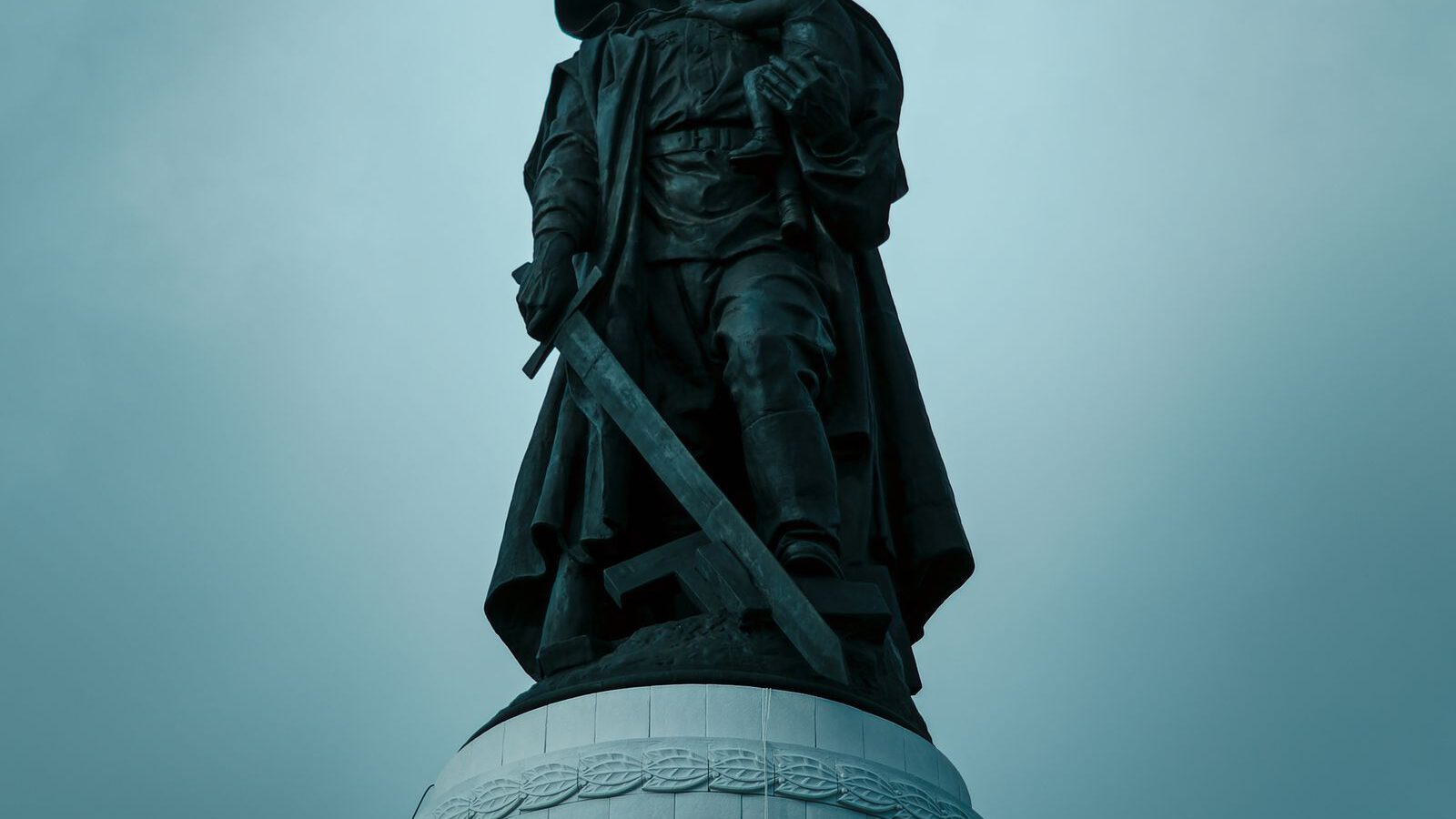
- The soldier. At the far end, on a grass mound, stands a roughly 12-metre bronze soldier, around 70 tonnes, holding a German child in one arm, his sword lowered onto a broken swastika. Marshal Vasily Chuikov linked it to Sergeant Nikolai Masalov, who is said to have carried a German girl out of the line of fire during the final battle.
Steps lead up the mound to the plinth, which holds a small memorial hall with a gold-ground mosaic by Alexander Gorpenko: Soviet citizens of every age and background laying a wreath. Access to the interior is not something to count on, so treat it as a bonus if the door is open. The statue itself was taken down and restored in 2003–04, and it shows: the bronze looks in good shape up close.
Why it beats the memorial everyone else sees
The Tiergarten memorial is worth thirty seconds if you pass it, but it is hemmed in by traffic and tour groups. Treptow is the full statement: Stalin-era monumentalism at a scale that is hard to grasp until you have walked the length of it. Read the inscriptions with some scepticism. This is a monument to victory and to the dead, and also a piece of state propaganda, which is exactly what makes it worth seeing. The tone is grave rather than triumphant, and the silence across the open field does a lot of the work.
Getting there and finding the way in
- S-Bahn: ride to Treptower Park, served by the Ringbahn (S41/S42) and through lines including the S8, S9 and S85. Head south-east into the park; the gateways are about 10–15 minutes on foot.
- Bus: lines 165, 166 and 265 stop at Sowjetisches Ehrenmal, the closest stop, with night buses N60 and N65 on the same corridor.
- Address: Am Treptower Park 50, 12435 Berlin, with the second entrance from Puschkinallee.
The main paths are step-free and the city lists the site as wheelchair-accessible with orientation aids for blind visitors, but some parts, including the steps up the mound, are not step-free. The park around it has just been refurbished, with new water-permeable paths and fresh planting completed in 2026.
Hours, etiquette and the two days to plan around
There is no ticket, no booking and no fence to pay at: it is an open-air public monument inside the park. Daylight is the time to come, because the reliefs need light to read and the paths are dark at night. Allow 45 minutes to an hour to walk the axis properly, longer if you read the sarcophagi. Mornings and weekdays are the quietest. The central field has no shade, so bring sun cover in summer and an extra layer in winter.
Remember that you are walking through a cemetery. Keep voices down, keep off the grave fields, and leave the climbing-on-plinths photos to someone else. On 8 and 9 May, the anniversaries of the war’s end in Europe, the memorial fills with wreaths, delegations and sometimes tense gatherings. In recent years Berlin police have issued special rules for the area on those days, banning military uniforms and restricting flags. If you want a contemplative visit, avoid those dates; if you want to see how loaded this place still is, they are the most revealing days of the year.
Make an afternoon of Treptower Park
The memorial is only one part of a large, very local riverside park, and the mood swings quickly once you leave it.
- Archenhold Observatory (Alt-Treptow 1), on the park’s eastern side, houses a 21-metre refracting telescope from 1896, billed as the longest movable lens telescope in the world. Tickets cost around €12; check planetarium.berlin for demonstrations and opening times.
- Zenner, a historic inn reopened as a huge beer garden on the Spree at Alt-Treptow 15, is the obvious place for a drink afterwards.
- Insel der Jugend, reached by a footbridge near Zenner, is a small island with a completely different, easy-going feel.
If you still have energy, the Ringbahn takes you two stops to Neukölln, where you can wander the cobbled lanes of Rixdorf's Bohemian village and finish the day with a sunset drink at Klunkerkranich, the rooftop garden bar on a car park, a short walk or one U7 stop north of Rixdorf.