A waterfall and a monument on Berlin’s inner-city peak
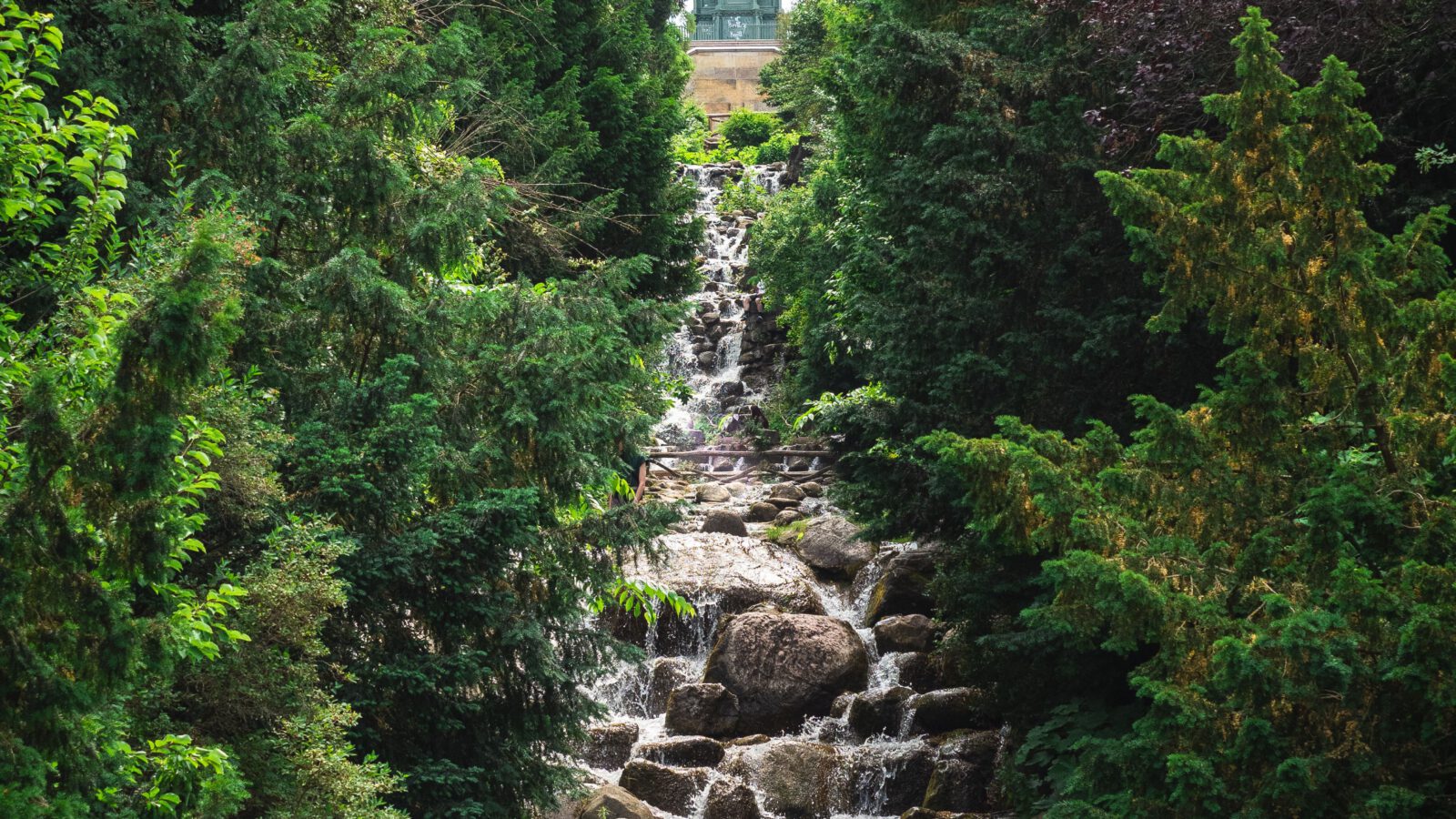
Viktoriapark drapes over the Kreuzberg, the 66-metre hill that is the highest natural point in Berlin’s inner city and gave the whole district its name. Laid out from the late 1880s, it packs in two things flat Berlin has no business owning. First, a 24-metre artificial waterfall tumbling down the southern slope — a faithful copy of a real cascade in the Giant Mountains (Krkonoše, on today’s Czech–Polish border), the only cheat being the electric pump that recirculates the water. Second, at the summit, Karl Friedrich Schinkel’s cast-iron National Monument of 1821, a slender neo-Gothic spire commemorating Prussia’s dead from the Wars of Liberation against Napoleon. There’s even a working vineyard on the north flank.
That monument is why the whole district is called Kreuzberg — “cross mountain.” Schinkel topped his spire with an Iron Cross, and the hill and the neighbourhood took their name from it. Up close you’ll spot allegorical figures set into the base, each personifying a battle from the campaigns against Napoleon, modelled with the faces of Prussian royals and generals of the day. The park itself was landscaped around the monument in the 1880s by Hermann Mächtig, who added the waterfall as its showpiece — so the “natural” hill you climb is in fact a carefully composed piece of Victorian-era design.
Why bother — you can’t see the whole city
True, it’s not a 360-degree panorama. What it is, is the best free elevated view in central Berlin: climb to the monument terrace and Kreuzberg’s rooftops fall away north toward the TV Tower and the skyline, with no ticket, no lift and no queue. Skip the paid Panoramapunkt at Potsdamer Platz for this and you keep your money and gain a better atmosphere — this is a real neighbourhood hill where locals sprawl on the grass with beers at golden hour, not a viewing platform. The waterfall gives it a centrepiece no other Berlin park has, and it’s compact enough to fold into an evening of Kreuzberg bar-hopping.
How to get there — and the right way up
Two U-Bahn stations put you at a park gate in 5–10 minutes on foot: Mehringdamm (U6/U7) or Platz der Luftbrücke (U6). Here’s the move most people get wrong: don’t take the road up. Enter at the bottom of the waterfall and climb the stepped path that runs right alongside the falling water. It’s prettier, it’s shaded, and it delivers you straight onto the monument terrace and the view — the payoff at the top of a proper little climb rather than a flat approach.
When to go, and what it costs
The park is free and open around the clock as public green space. The one big caveat: the waterfall only runs in the warmer months — broadly spring to early autumn — and is switched off over winter, so if the cascade is your reason to come, aim for roughly May to September. Late afternoon into sunset is the payoff hour at the summit. You’ll spend nothing unless you stop at the Golgatha beer garden below the hill, a Kreuzberg institution since 1977 that stays open late into summer nights.
Insider moves
Bring your own drink and a blanket and claim a spot on the grass just below the monument about an hour before sunset — that terrace is where Kreuzberg comes to watch the sky go pink. The vineyard on the north slope is a curiosity worth a look: it has produced grapes since the 1970s, but you won’t find the wine for sale — the district office keeps it for gifts and ceremonies. And if you’ve got kids, the long summer toboggan-style slope and playgrounds on the eastern side keep them busy while you take in the view.
Pair it with
The park spills straight into the Bergmannkiez, one of central Berlin’s nicest wanders. Head down toward Bergmannstraße for its cafés and the covered Marheineke market hall, and detour a block to Chamissoplatz — a cobbled square ringed by unrenovated 19th-century tenements with their original façades, one of the best-preserved streetscapes in the city. Waterfall and view first, then an unhurried afternoon of coffee and browsing just downhill: that’s the classic Kreuzberg combination.