A hill made of war, topped with spy domes
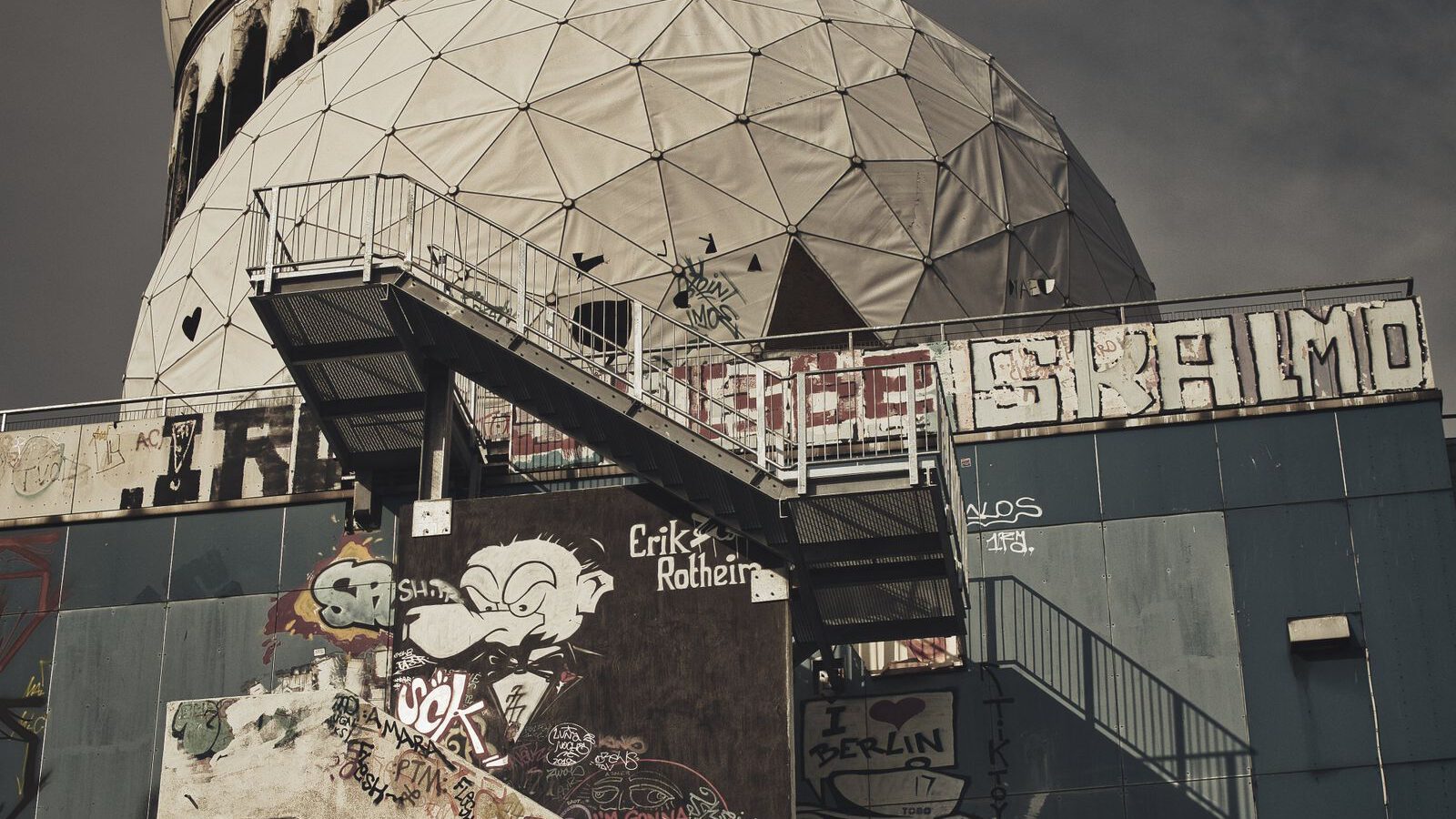
Teufelsberg — “Devil’s Mountain” — is not a natural hill. After 1945 the Allies had to put the pulverised remains of bombed Berlin somewhere, so for two decades they trucked an estimated 26 million cubic metres of rubble to this corner of the Grunewald forest and piled it roughly 120 metres high. Underneath the grass and pine trees sits a half-finished Nazi military-technical college, too solid to demolish, simply buried. During the Cold War the US Army and Britain’s signals intelligence built a listening station on the summit, its bulbous white radomes hoovering up radio and radar traffic from the Eastern Bloc until the Wall came down. The spies left in the early 1990s; the golf-ball domes stayed. Today the abandoned complex is a legal, ticketed open-air gallery, and its crumbling floors hold one of Europe’s largest concentrations of graffiti and mural art.
What you actually see up there
The star is the big tower dome. Climb the internal stairs to the top radome and you get two payoffs at once: a wide view over the Grunewald treetops toward the distant city skyline, and the acoustics. The curved fibreglass shell is a whispering gallery on steroids — clap once and it rings, hum a note and it hums back, and buskers set up here precisely because a saxophone or a cello sounds enormous inside. Below the domes, the shell of the office block is layered floor to ceiling in spray paint that changes constantly, because artists keep painting over each other. It is scruffy, weatherbeaten and genuinely atmospheric rather than polished — think ruin, not museum.
Is it worth it — or just go up the TV Tower?
Go here. The Fernsehturm gives you a higher, cleaner view for more money and a lift queue; Teufelsberg gives you a view plus a story you cannot get anywhere else: Nazi ruins, Allied espionage, post-Wall decay and street art stacked into a single hill. It rewards curiosity, not box-ticking. If you want a manicured panorama it will disappoint you; if you want the strange, layered, only-in-Berlin version of a viewpoint, nothing else in the city comes close.
Getting there without getting lost
The address is Teufelsseechaussee 10, deep in the forest, and there is no station at the door — the walk is part of it. Two sensible approaches:
- From S-Bahn Grunewald (S7): head north-west into the woods and pick up the paths climbing to the summit — shorter as the crow flies but steeper and easier to lose.
- From S-Bahn Heerstraße (S3/S9): follow Teufelsseechaussee south; just past the foot of the Drachenberg a path branches right to the gate. Easier to navigate, about 25–30 minutes.
Bus 218 runs into the Grunewald and shortens the walk. Wear proper shoes — the forest tracks are unpaved and turn to mud after rain — and don’t rely on mobile data up here; download a map first.
Hours, tickets and the honest warnings
The site opens daily around 11:00 and closes at sunset, with last entry roughly an hour before — so closing drifts later in summer and much earlier in winter, and it’s shut on 24 and 31 December. Standard adult entry is about €12, reduced around €10, roughly €5 for ages 7–17, free for under-7s, with a family ticket near €27. You can turn up and pay, or pre-book a guided history or street-art tour if you want the full backstory rather than wandering blind. Bring cash: the kiosk and some tour extras are cash-friendly and there’s no reliable card fallback. This is a ruin with uneven floors, open edges and drops, so mind children and don’t go clambering where it’s taped off.
Insider moves
Stand dead-centre under the top dome and just listen for a minute before anyone else arrives — the echo is the single best thing here. Aim for a clear late afternoon so the low sun lights both the view and the murals. And here’s the free bonus most visitors miss: the neighbouring Drachenberg hill, a two-minute detour on the way in, gives an almost-as-good panorama over the Grunewald and city for exactly nothing — worth climbing whether or not you pay to go into the domes.