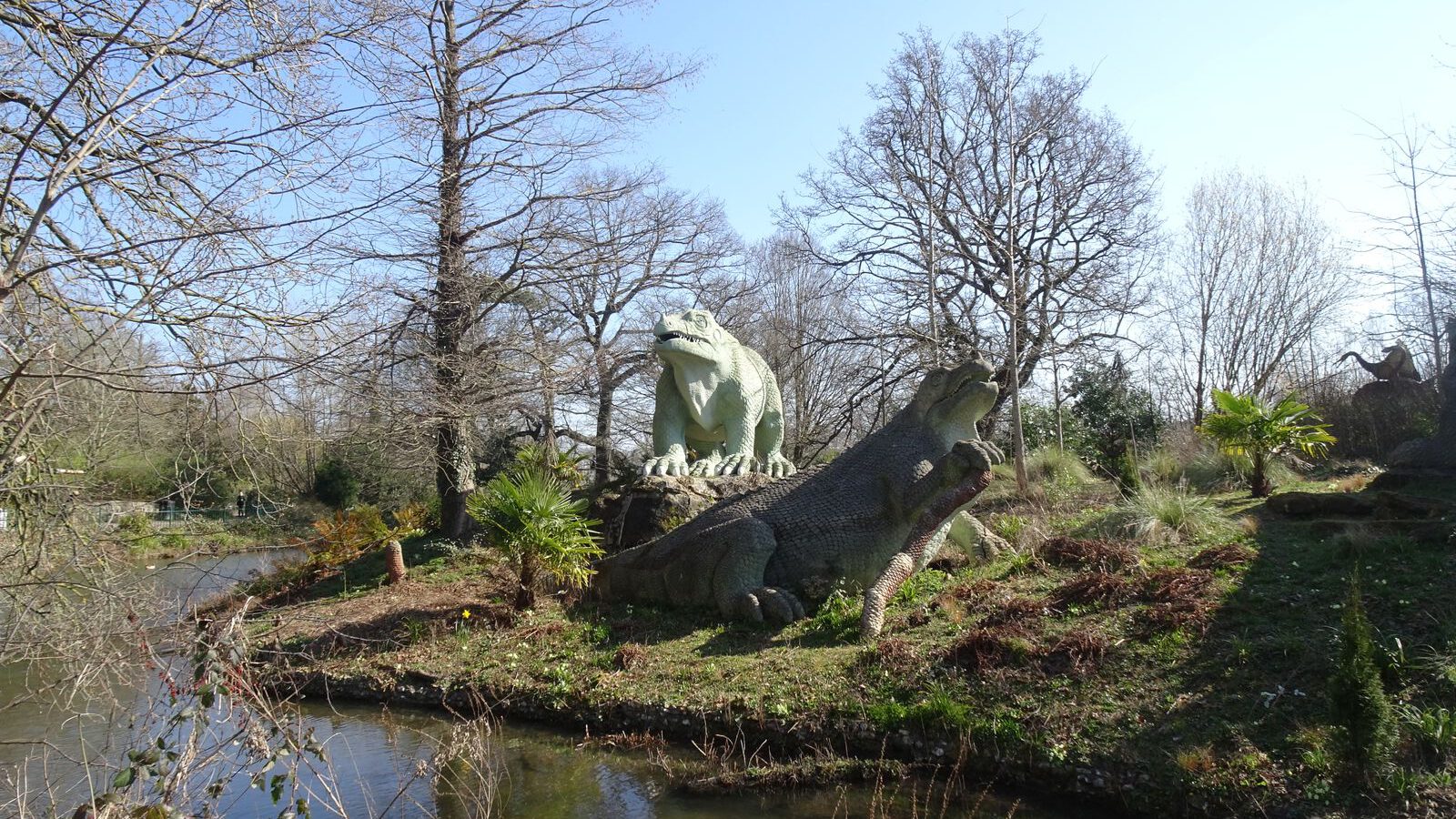
Long before Jurassic Park, before museum skeletons and plastic toys, before Darwin had published a word on evolution, Victorian Londoners took the train to Sydenham to meet monsters. They are still there. Around 30 life-sized sculptures of dinosaurs, sea reptiles and Ice Age mammals stand on wooded islands in the lakes of Crystal Palace Park, unveiled in 1854 and widely regarded as the first life-sized sculptures of extinct animals ever made. They are free to see, freshly restored, and wonderfully, instructively wrong.
The first time anyone tried to picture a dinosaur
When Joseph Paxton’s giant glasshouse from the Great Exhibition was rebuilt on this hilltop in south London, its owners wanted the grounds to educate as well as entertain. The sculptor Benjamin Waterhouse Hawkins was commissioned to bring the newly discovered “antediluvian” world to life, with scientific direction from Richard Owen, the anatomist who had coined the word “Dinosauria” only a decade earlier. Hawkins built his creatures between 1852 and 1854, and on New Year’s Eve 1853 he famously hosted a dinner for Owen and around twenty guests inside the mould of one of the Iguanodons.
The sculptures were laid out across three islands representing successive eras of Earth’s history, from ancient amphibians through the age of reptiles to giant mammals, alongside an artificial rock face showing layers of geology. Water levels in the lake were even varied so the animals appeared to wade, swim or loom from the shallows. It was, in effect, the world’s first prehistoric theme park, and it helped kick off the first great wave of dinosaur mania.
Gloriously wrong, and freshly repainted
Half the joy is spotting what the Victorians got wrong. The Iguanodons stand on all fours like hulking rhinos, with a horn on the nose; that spike turned out, after better fossils were found in the 1870s, to belong on the thumb. The Megalosaurus is shown as a four-legged beast with a hump it never had. By contrast, the later mammals, such as the giant ground sloth Megatherium and the huge-antlered Megaloceros, hold up rather better. The point is not accuracy but time travel: you are looking at the very first attempt to imagine prehistoric life.
Grade I listed since 2007, the sculptures had suffered cracks, weathering and vandalism, and spent years on Historic England’s Heritage at Risk Register. A multi-million-pound conservation project, delivered by Bromley Council and the Crystal Palace Park Trust with National Lottery Heritage Fund support, finished in July 2026: the animals were repaired, partly using 3D printing, and repainted in colours based on their original Victorian appearance, and they have now come off the at-risk list.
How to see them
The dinosaurs live by the lakes in the south-eastern part of the park, near the Penge Gate on Thicket Road and the new visitor centre. You view them from the paths around the water rather than walking among them, so walk the full loop to see every group. A few tips make the difference:
- Bring binoculars if you have them. Some sculptures sit well back on the islands and the Friends of Crystal Palace Dinosaurs recommend them for picking out detail.
- Step-free route: there is a step-free way round, but parts of it are unpaved footpath that gets muddy after rain, so wear proper shoes.
- Island access is not possible day to day. The Friends occasionally run free, pre-booked tours onto the islands on special open days; the route involves a narrow bridge and a steep, muddy path, so it is not suitable for wheelchairs or buggies.
- Audio and background: the Friends’ website has notes on every statue and links to an audio trail, worth a skim on the train.
Getting there: Crystal Palace station or the Penge Gate
Crystal Palace station sits on the park’s edge and has direct Southern trains from London Victoria (about 26–30 minutes) and London Bridge (about 20–25 minutes), plus the Overground’s Windrush line. From the station it is a walk of roughly 15 minutes downhill through the park to the lakes. Penge West, also on the Windrush line, is about five minutes’ walk along Thicket Road from the Penge Gate, the closest entrance to the dinosaurs; Penge East is roughly 15 minutes away. A long list of buses serves the area. If you drive, the paid car park at the Penge entrance is nearest, with toilets and a café alongside.
Timing, weather and bringing the kids
Seeing the dinosaurs is free, with no ticket or booking. The park gates open early in the morning and close at times that shift through the year, from around 4.30pm in December to well into the evening in midsummer, so check the Crystal Palace Park Trust’s current times for winter visits. This is an entirely outdoor trip: pick a dry day, ideally with low sun for photos across the water, and allow an hour for the dinosaurs alone or half a day with the wider park.
For families it is one of the best free days out in London. Instead of shuffling through the queue for the dinosaur gallery at the Natural History Museum in South Kensington, children here get to hunt for monsters through the trees. A new dinosaur-themed playground opened near the lakes in March 2026, with a skeleton climbing frame, giant eggs and a fossil-hunting sandpit, plus accessible equipment and a Changing Places toilet close by.
Making a day of the rest of the park
The regeneration that rescued the dinosaurs also restored the grand Italian Terraces at the top of the park, where Paxton’s palace stood until it burned down in 1936; his bust has been put back, and the sphinxes still guard the steps. The new visitor centre, opened in July 2026, has a permanent exhibition on the park’s history, and the small volunteer-run Crystal Palace Museum near the station tells the palace’s story, typically on Friday and Sunday, with free entry. There is also a hedge maze and plenty of lawn for a picnic.
If big, green, out-of-the-centre London is your kind of day, the Hampstead Heath ponds make a fine north-London counterpart. And if the Victorian urge to collect and display the past fascinates you, the cluttered genius of Sir John Soane's Museum is the indoor version.