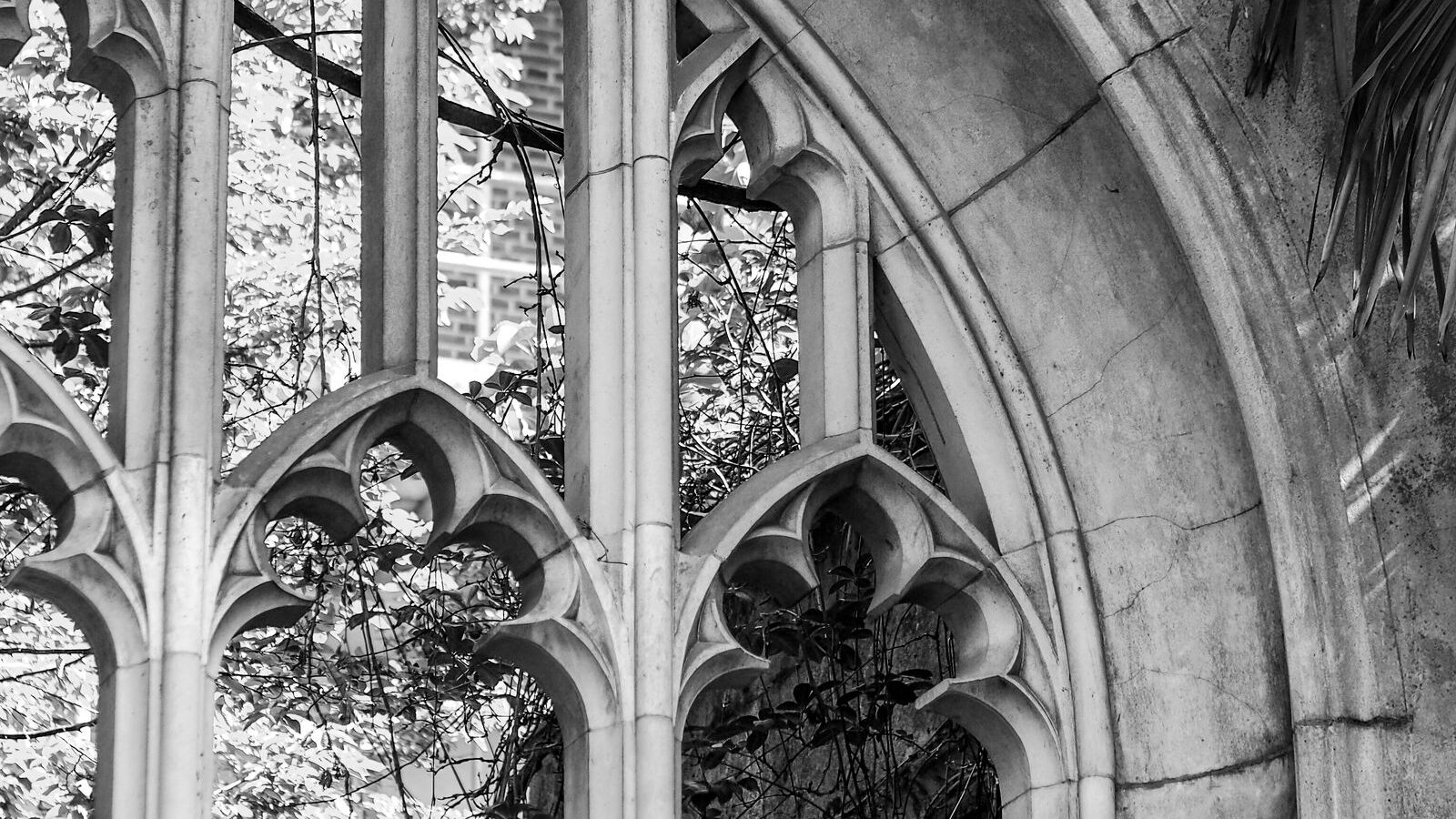
Most people who pass within a hundred metres of St Dunstan-in-the-East never know it is there. The lanes around it are all office backs and delivery bays, the traffic on Lower Thames Street never lets up, and then you step through a gate in an old wall and the noise falls away: a roofless nave, tall Gothic window frames filled with leaves instead of glass, ivy and creeper pouring down the stone, a small lawn, a few benches and a low fountain. Above it all rises a Christopher Wren tower that the bombs missed. It is free, it takes twenty minutes, and it is one of the most quietly extraordinary spaces in the City of London.
Nine centuries, one fire and one air raid
There has been a church on this slope above the Thames since around 1100. The Great Fire of 1666 left it badly damaged, the shell was repaired, and between 1695 and 1701 Wren added the tower and steeple you still see: an unusual Gothic design with a slender needle spire carried on four flying buttresses. The body of the church was rebuilt once more in 1817–21 by David Laing and William Tite after the old structure became unsafe, so the window tracery framing everyone’s photos is early-19th-century Gothic rather than medieval.
Then came the Blitz. Bombing in 1941 left little more than the north and south walls and Wren’s tower. The church was never rebuilt, and in 1967 the City of London Corporation made the unusual decision to turn the ruin into a public garden, which opened in the early 1970s. The ruin is Grade I listed and the City still looks after it. The tower now houses a charitable foundation and is not part of the visit, so admire the spire from below.
What you will find inside the walls
The garden is laid out on several levels in and around the old nave. Where the congregation once sat there is now a circular cobbled area with a low fountain, ringed by lawn and benches, and trees grow up into the space where the roof used to be. The walls are draped in ivy and Virginia creeper, which turns gold and red as autumn sets in, making October and early November arguably the most photogenic time to come. In the lower garden, look out for Winter’s bark (Drimys winteri), a shrub whose vitamin-rich leaves were once eaten to ward off scurvy, a fitting plant for a parish a stone’s throw from the river.
Keep your expectations in proportion. This is a garden, not an attraction: there is no ticket desk, café or gift shop, and nothing to do beyond sit, look and wander. Ten to twenty minutes covers it, longer if you bring lunch and claim a bench.
Getting there: which station, which lane
The garden sits between Great Tower Street and Lower Thames Street (postcode EC3R 5DD), roughly halfway between the Tower of London and London Bridge. There are two ways in, from St Dunstan’s Hill and from Idol Lane; both lanes run downhill off Great Tower Street, and the entrances are modest gates in a wall, so use the spire as your landmark.
- Monument (District and Circle lines, linked underground to Bank) is about five minutes away. Walk east along Eastcheap, which becomes Great Tower Street, and watch for the tower on your right.
- Tower Hill (District and Circle lines) is also about five minutes’ walk, and the natural approach if you are coming from the Tower.
- London Bridge and Cannon Street mainline stations are a ten-minute walk if you arrive by train.
The main paths are largely flat and paved, but this is a ruin built on a slope, so expect some uneven ground and the odd step if you are using a wheelchair or pushing a buggy.
Dodging the lunch crowd and the photographers
The garden is open daily from 8am to 7pm, or until dusk if that is earlier, so on a winter afternoon the gates can close well before 5pm. Entry is free and there is nothing to book. If you are planning around a particular time, check the City of London’s gardens page first, as hours shift with the seasons.
The place has two kinds of rush hour. On weekdays, City workers can arrive around lunchtime with sandwiches, and on weekend mid-mornings photographers, couples doing portrait shoots and the Instagram crowd take over. The hushed, ruins-to-yourself version is most likely early in the morning, close to opening, or late on a weekday afternoon once the offices have reclaimed their staff. A grey, misty morning suits the ruin far better than harsh midday sun anyway.
Photos, picnics and a few house rules
Casual photography is fine. Organised shoots with a crew or a professional photographer need a permit from the City of London, and the garden can be hired for private events, so occasionally part of it may be in use. A sandwich on a bench is entirely in the spirit of the place; just take your rubbish with you and keep the volume down, because the hush is half the point.
A low-cost City walk built around the ruin
On its own St Dunstan’s is a short stop, so make it part of a loop. Instead of spending your whole morning queueing at the Tower of London, where an adult ticket now costs well over £30, string together the free and cheap sights within a few minutes’ walk:
- All Hallows by the Tower, about five minutes east, is the oldest church in the City, founded in 675. Its crypt museum is free and includes a stretch of Roman pavement; note it closes to sightseers on Sundays, when it opens only for services.
- The Monument to the Great Fire, a few minutes west, can be climbed (311 steps) for about £7 for an adult, with a lunchtime closure.
- The Sky Garden at 20 Fenchurch Street, five minutes north, is free but needs a timed ticket. Slots are released online on Monday mornings about three weeks ahead and go quickly.
- Leadenhall Market, around ten minutes north, is the place for lunch under an ornate Victorian roof.
If you are carrying on east, Wilton's Music Hall is roughly a twenty-minute walk beyond Tower Hill, and its faded Victorian bar makes a fine end to a day of City history. And if plants growing where they have no business growing are your thing, the Barbican Conservatory offers the brutalist, tropical take on the same idea.