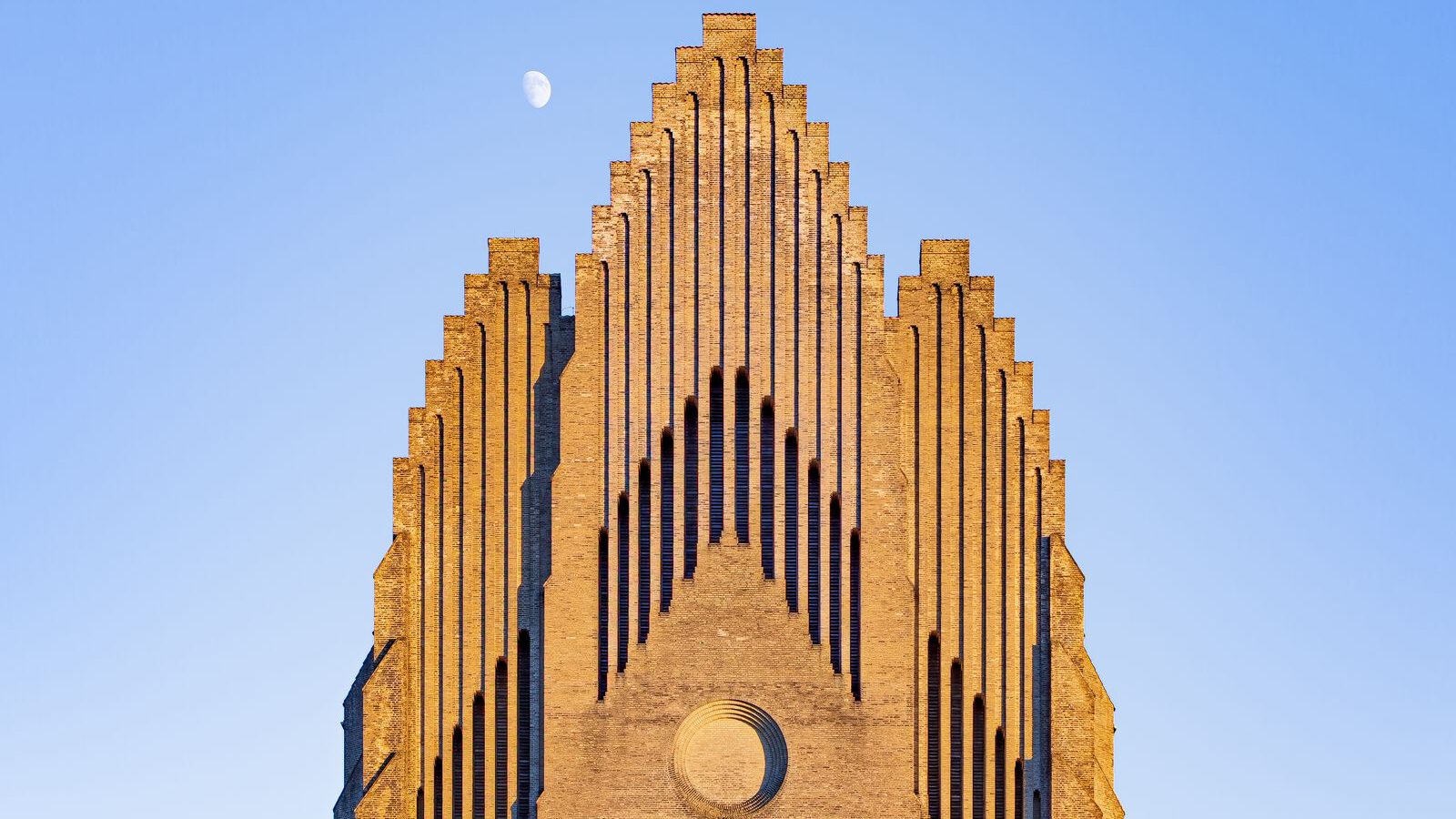
Most visitors to Copenhagen never make it as far as Bispebjerg, a quiet residential district on a hill north-west of the centre. That is their loss. On top of that hill stands Grundtvigs Kirke, a church that looks from the outside like a colossal pipe organ and feels on the inside like a cathedral carved out of a single block of pale yellow clay. It is free, it is rarely busy, and it is one of the most remarkable buildings in Denmark.
A memorial that took almost twenty years to build
The church is a monument to N.F.S. Grundtvig, the 19th-century pastor, hymn writer and thinker who shaped Danish schooling and much of the country’s sense of itself. After years of arguing over a suitable memorial, the commission went to architect Peder Vilhelm Jensen-Klint, and the foundation stone was laid on Grundtvig’s birthday, 8 September 1921. The tower went up first and served as a temporary parish church from 1927. Jensen-Klint died in 1930 with the drawings finished but the nave unbuilt; his son Kaare Klint completed it, and the full church was consecrated on 8 September 1940, Grundtvig’s birthday again.
The material is the story. Everything you see is built from yellow brick, roughly five million of them according to the parish (some sources round it up to six). The core of the great columns is not poured concrete but brick laid stone by stone, and on the interior walls the hard outer skin of every brick was ground down by hand, which softens both the light and the acoustics.
What to look for once you are inside
You enter through a deliberately dim porch, so the nave hits you all at once: 76 metres long, 22 metres high, almost bare, washed in pale northern light. Give your eyes a minute, then hunt for the details most people walk past:
- The chairs. Kaare Klint, later celebrated as a father of Danish modern furniture, designed the simple woven-seat church chairs that fill the nave instead of pews.
- Two organs and two pulpits. Because the church was built in two phases, it has a pair of each. The big west organ, inaugurated in 1965, has a 32-foot bass pipe of more than 11 metres, billed as the largest facade pipe in Scandinavia.
- The ship. A model barque, the Dronning Alexandrine, hangs in the south aisle, a Danish church tradition.
- The architect himself. Jensen-Klint’s urn is set into the wall of the porch, so he still greets everyone who comes in.
Read the street, not just the church
Before you leave, walk a slow lap of På Bjerget, the low terraces that wrap around the church. Built in the mid-1920s as municipal housing, their exteriors were drawn by Jensen-Klint in the same yellow brick, so church and neighbourhood speak one language. The site sits about 31 metres above sea level, high ground by Copenhagen standards, and the planners lined up the streets on the church: Bispebjerg Hospital to the east, Bispebjerg Cemetery to the west. Ten minutes on foot is enough to see how deliberately the whole hill was composed.
Getting up the hill: bus 6A or the F line
The simplest route is bus 6A from Nørreport towards Buddinge. Get off at Bispebjerg Torv, about 15–20 minutes from the centre, and the church is a two-minute walk away. By S-train, take line F to Bispebjerg station. From there it is roughly 1.4 km and 15–20 minutes uphill along Tagensvej, or you can hop on the 6A for the last few stops. The address is På Bjerget 14B. Drivers get three hours of free parking by the church, but do not park on the surrounding grass, which belongs to the city and is fined.
Access is better than you might expect for a building of this age. The tower porch has a single step of about 20 cm with a ramp available, the south porch by the church office is level, and the nave itself is all on one floor. The crypt is reached by stairs with stair lifts; ask a verger to help.
Opening hours change every week, so check first
This is a working parish church, and it publishes its visiting hours week by week, because funerals can be booked at short notice. Admission is free. It is closed on Mondays. The schedule posted in autumn 2026 had it open Tuesday to Friday from mid-morning to mid-afternoon (shorter on Wednesday), closed on Saturday, and open on Sunday afternoon after the morning service. Other weeks may differ, so look at the “Åbningstider/Opening hours” page on grundtvigskirke.dk the day before you go. There is no sightseeing during services, and the church is closed to tourist visits on Good Friday, Christmas Eve, Christmas Day, Boxing Day and New Year’s Day.
Allow 30–45 minutes inside, an hour with the walk around På Bjerget. Late morning on a weekday tends to be quietest. Personal photos are fine, but commercial and bridal shoots need written permission in advance. Keep voices low; locals come here to pray, not just to look.
Free organ concerts and tower tours
The church hosts free organ concerts on the first Thursday of the month, plus a summer series on Thursdays in August. Occasional public tours in Danish (around 50 kr, 20 kr for under-12s) open up the crypt, the roof timbers and the tower, with views back towards the city skyline. There are stairs and no lift, and dates are announced in the church calendar.
Cherry blossom next door, and where to go after
Directly west lies Bispebjerg Cemetery, whose short avenue of Japanese cherry trees turns pink around mid-to-late April and draws crowds the municipality has put at around 150,000 visitors during a single short bloom. Here is the trick: while everyone is photographing blossom, the far bigger spectacle a few hundred metres away stays almost empty. Visit both in one morning and you get Copenhagen’s most crowded spring sight and its most peaceful interior back to back.
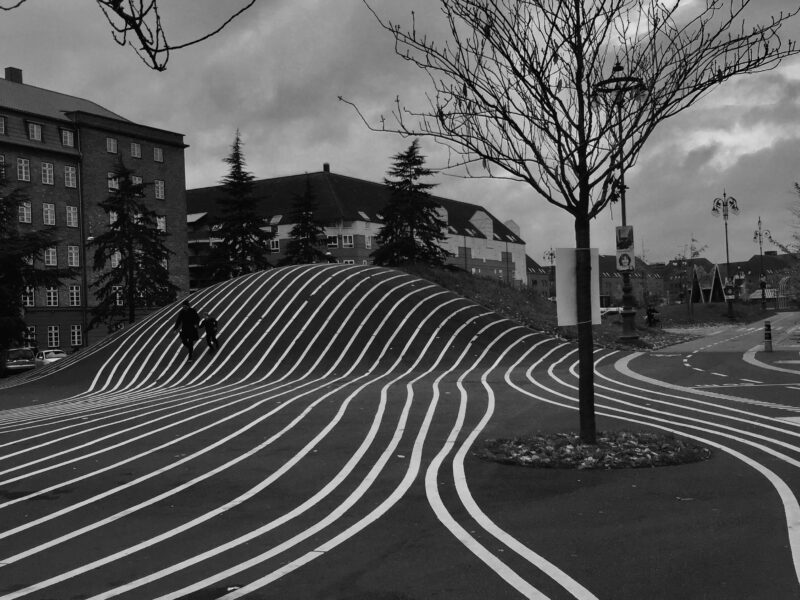
There is little to eat on the hill beyond a few neighbourhood shops around Bispebjerg Torv, so bring water or plan lunch elsewhere. The F line makes an easy onward hop: Nørrebro station is one stop south, right beside the open-air world-in-a-park of Superkilen in Nørrebro, and from there it is a short walk to cafés and bakeries. If quiet green spaces are your thing, the graves and lawns of Assistens Cemetery make a natural second stop on the same afternoon.